
Digital Kaleidoscope: Geometric Symmetry via Rotation and Mirror
Loading the math board and drawing, please wait…
In collections
Flip & turn
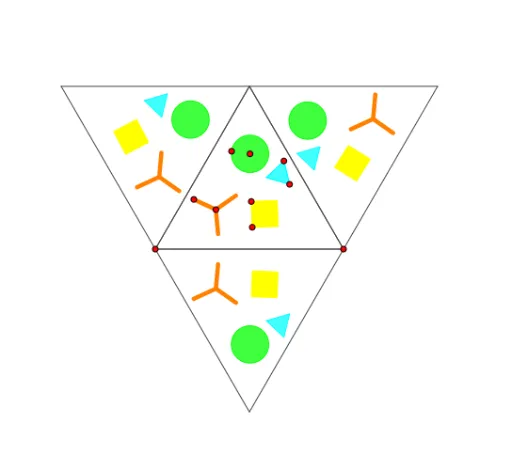
This example demonstrates the generation of kaleidoscopic patterns through geometric transformations. Key concepts involve rotational symmetry, reflectional symmetry, and polygon construction. The construction utilizes GeoGebra commands such as Rotate, Mirror, Polygon, and Circle to replicate and transform base shapes into complex symmetric designs. It is suitable for teaching symmetry in geometry classes or for exploring mathematical art and visual patterns.
GeoGebra Commands & Parameters
Polygon(A, B, 3) → poly1, a, b, c, CPointIn(poly1) → DPointIn(poly1) → EPointIn(poly1) → FPointIn(poly1) → GPointIn(poly1) → HPointIn(poly1) → IPointIn(poly1) → JPolygon(H, G, 4) → poly2, d, e, f, g, K, LPolygon(J, I, 3) → poly3, h, i, j, MCircle(E, F) → kPointIn(poly1) → NRotate(N, 120°, D) → N'Rotate(N, 240°, D) → N'_1Segment(N', D) → lSegment(N, D) → mSegment(D, N'_1) → nMirror(poly3, b) → poly3'Mirror(poly3, a) → poly3'_1Mirror(poly3, c) → poly3'_2Mirror(C, b) → C'Mirror(A, b) → A'Segment(C', A') → c'Mirror(A, b) → A'_1Mirror(B, b) → B'Segment(A'_1, B') → a'Mirror(C, a) → C'_1Mirror(A, a) → A'_2Segment(C'_1, A'_2) → c'_1Mirror(B, a) → B'_1Mirror(C, a) → C'_2Segment(B'_1, C'_2) → b'Mirror(A, c) → A'_3Mirror(B, c) → B'_2Segment(A'_3, B'_2) → a'_1Mirror(B, c) → B'_3Mirror(C, c) → C'_3Segment(B'_3, C'_3) → b'_1Mirror(poly2, a) → poly2'Mirror(poly2, b) → poly2'_1Mirror(poly2, c) → poly2'_2Mirror(k, b) → k'Mirror(k, a) → k'_1Mirror(k, c) → k'_2Mirror(N', a) → N''Mirror(D, a) → D'Segment(N'', D') → l'Mirror(D, a) → D'_1Mirror(N'_1, a) → OSegment(D'_1, O) → n'Mirror(N, a) → N'_2Mirror(D, a) → D'_2Segment(N'_2, D'_2) → m'Mirror(N', b) → N''_1Mirror(D, b) → D'_3Segment(N''_1, D'_3) → l'_1Mirror(D, b) → D'_4Mirror(N'_1, b) → PSegment(D'_4, P) → n'_1Mirror(N, b) → N'_3Mirror(D, b) → D'_5Segment(N'_3, D'_5) → m'_1Mirror(N, c) → N'_4Mirror(D, c) → D'_6Segment(N'_4, D'_6) → m'_2Mirror(N', c) → N''_2Mirror(D, c) → D'_7Segment(N''_2, D'_7) → l'_2Mirror(D, c) → D'_8Mirror(N'_1, c) → QSegment(D'_8, Q) → n'_2
AI Drawing Prompt Reference
Draw a geometric symmetric pattern created by rotation and reflection. Start by constructing a triangle and selecting several random points inside it. Build multiple quadrilaterals and triangles based on these points. Then, draw circles centered at these points and use rotation and reflection to replicate and transform the basic shapes, creating a complex symmetric design. The final image should exhibit rotational and reflective symmetry, resembling a kaleidoscope pattern.
The prompt above was compiled from the original drawing commands and is for reference only.