
Differentiation - Cuboid Optimisation
Loading the math board and drawing, please wait…
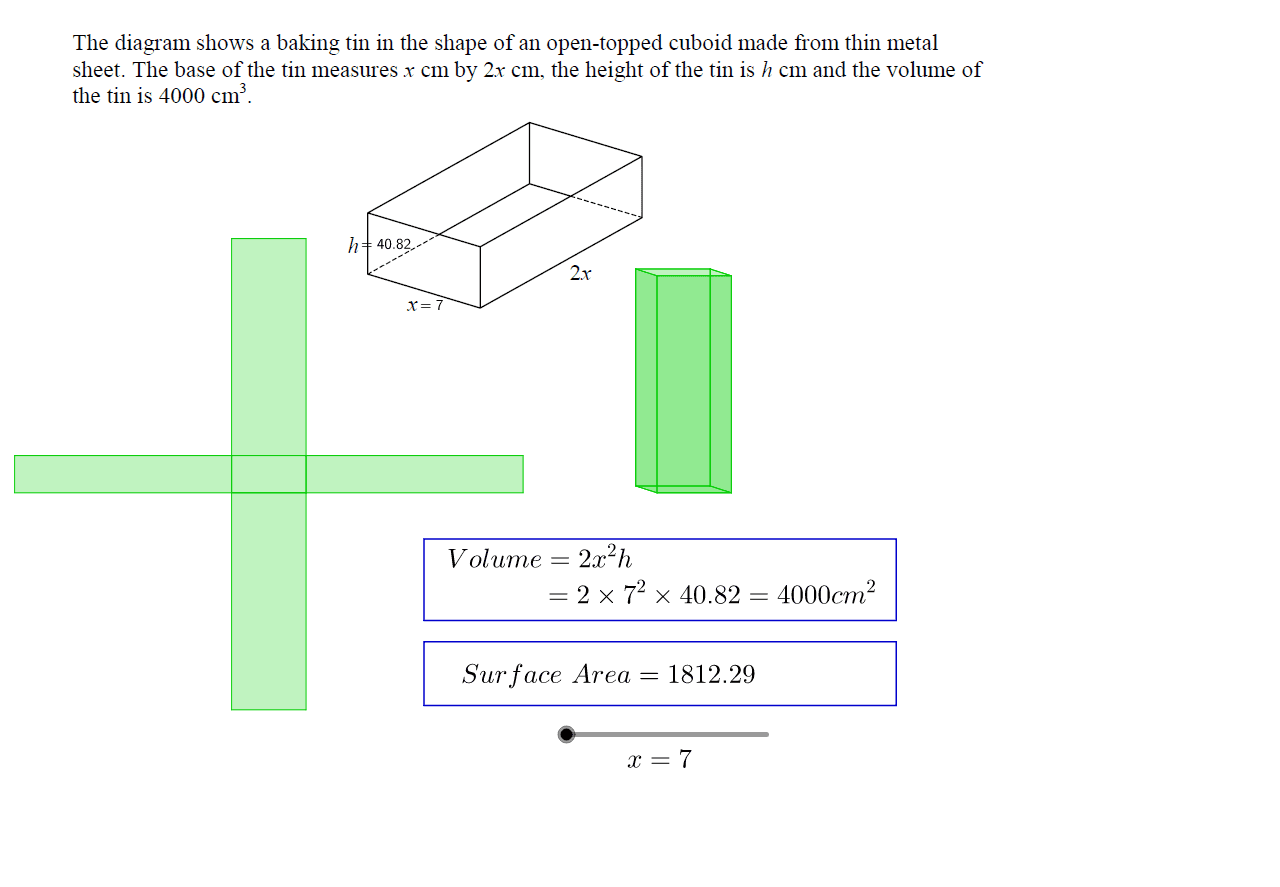
This example demonstrates how to find the dimensions of a cuboid that minimize surface area under a fixed volume using calculus. Key concepts include derivatives, optimization, and solid geometry. Construction involves GeoGebra commands like Polygon, a, A, B, C, D, etc. Suitable for high school students or college freshmen learning calculus and geometry.
GeoGebra Commands & Parameters
Polygon(D, C, B, A) → poly1, d, c, b_1, a_1Polygon(E, F, D, A) → poly2, e, f, d_1, a_2Polygon(D, H, G, C) → poly3, d_2, h, g, c_1Polygon(J, A, B, I) → poly4, j, a_3, b_2, iPolygon(B, K, L, C) → poly5, b_3, k, l, c_2Polygon(N, P, O, M) → poly6, n, p, o, mPolygon(R, N, M, Q) → poly7, r, n_1, m_1, qPolygon(Q, M, O, S) → poly8, q_1, m_2, o_1, sPolygon(R, T, P, N) → poly9, r_1, t, p_1, n_2Polygon(R, T, S, Q) → poly10, r_2, t_1, s_1, q_2Polygon(T, P, O, S) → poly11, t_2, p_2, o_2, s_2Polygon(U, V, Z, W) → poly12, u_1, v_1, z_1, wPolygon(A_1, C_1, D_1, B_1) → poly13, a_4, c_3, d_3, b_4
AI Drawing Prompt Reference
Draw a cuboid and optimize its dimensions to minimize the surface area while keeping the volume constant. Start by drawing four vertices A, B, C, and D, then connect them to form the base ABCD, side ADEA, side BCFB, and side CDHC. Continue by adding other vertices and faces such as E, F, G, H, I, J, K, L, M, N, O, P, Q, R, S, T, U, V, W, X, Y, and Z, and connect them to form the remaining faces.
The prompt above was compiled from the original drawing commands and is for reference only.