
Diameter of a Decagon
Loading the math board and drawing, please wait…
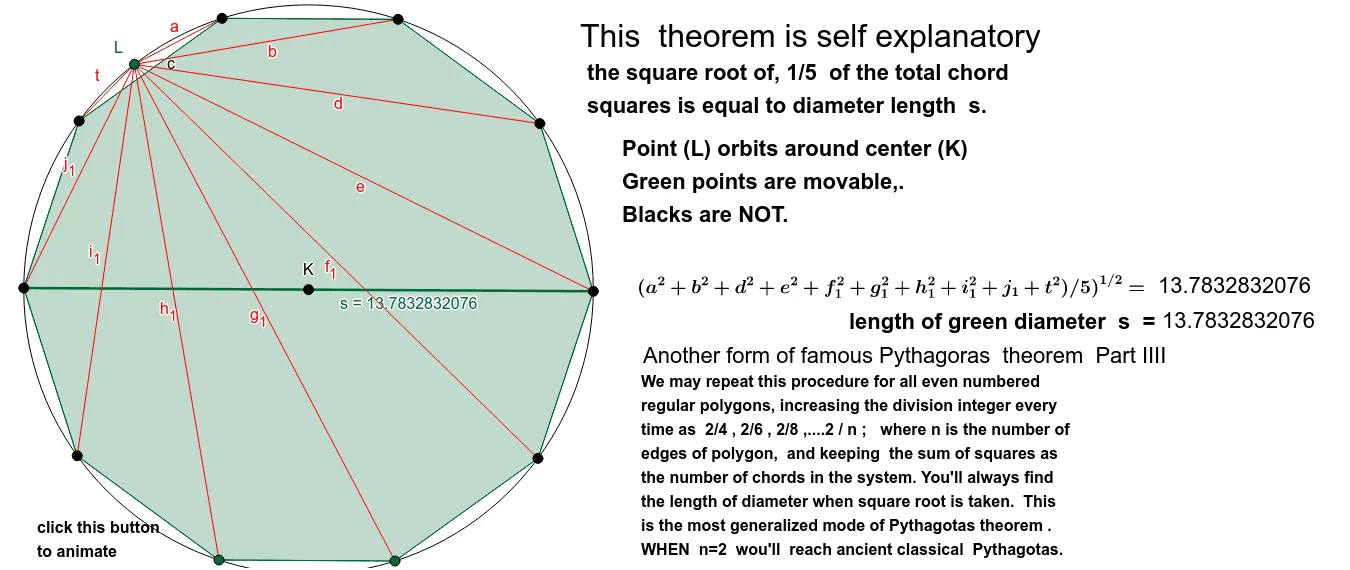
This example demonstrates the diameter of a regular decagon and its relationship with the circumcircle. Key math concepts include polygon, circle, geometric construction, symmetry. Construction highlights involve Polygon, LineBisector, Intersect, Segment, Circle, and Point commands. Suitable for high school geometry learning and competition training, helping understand properties of regular polygons.
GeoGebra Commands & Parameters
Polygon(A, B, 10) → poly1, f, p, C, D, E, F, G, H, I, J, g, h, i, j, k, l, m, nLineBisector(I, J) → qLineBisector(G, F) → rIntersect(q, r) → KSegment(I, D) → sCircle(K, E) → cPoint(c) → LSegment(L, H) → tSegment(L, G) → aSegment(L, F) → bSegment(L, E) → dSegment(L, D) → eSegment(L, C) → f_1Segment(L, B) → g_1Segment(L, A) → h_1Segment(L, J) → i_1Segment(L, I) → j_1
AI Drawing Prompt Reference
Draw a regular decagon and its circumcircle. Start by constructing the decagon with all vertices and edges. Find the perpendicular bisectors of two non-adjacent sides; their intersection is the center of the circumcircle. Use this center and one vertex to draw the circle, ensuring all vertices lie on it. Pick an arbitrary point on the circle, then draw segments from this point to each of the ten vertices, showing the relationship between the decagon's diameter and its circumcircle.
The prompt above was compiled from the original drawing commands and is for reference only.