
Diagonals of Isosceles Trapezoid
Loading the math board and drawing, please wait…
In collections
Quadrilaterals الرُباعيات
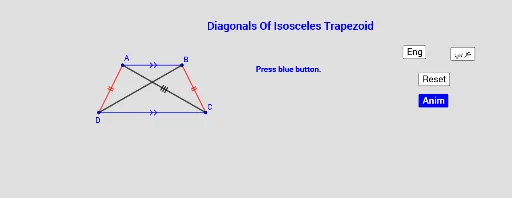
This example demonstrates the properties of the diagonals of an isosceles trapezoid. Key mathematical concepts include the definition of an isosceles trapezoid and the properties of its diagonals. Using GeoGebra commands such as Segment, Angle, Translate, Vector, Rotate, and Intersect, the interaction of the diagonals can be dynamically shown. Suitable for students in middle school and above to learn geometric construction and transformations.
GeoGebra Commands & Parameters
Segment(A, B) → fSegment(B, C) → gSegment(D, A) → iSegment(D, C) → hAngle(D, A, B) → αAngle(A, B, C) → βAngle(B, C, D) → γAngle(C, D, A) → δTranslate(C, Vector[(a * Vector[C, D])]) → C1Translate(B, Vector[(a * Vector[C, D])]) → B1Vector(C, D) → uVector(B, A) → vRotate(B1, (-((b * (180° - (2 * γ))))), C1) → B2Segment(D, B) → lSegment(A, C) → mTranslate(A, Vector[(a * Vector[C, D])]) → A1Segment(A1, C1) → jIntersect(m, l) → ERotate(A1, (-((b * Angle[B, E, A]))), C1) → A2Segment(C1, A2) → kSegment(D, B) → n
AI Drawing Prompt Reference
Draw an isosceles trapezoid ABCD with AB and CD as the bases and AD and BC as the legs. Draw the diagonals AC and BD and find their intersection point E. Then, using vectors from C to D, rotate point B and A to create new points B1 and A1. Draw line segments B1C1 and A1C1, and find their intersections with the original diagonals. Finally, draw the new line segments B1A1 and C1A1.
The prompt above was compiled from the original drawing commands and is for reference only.