
Diagonals of a Rhombus by Neal Creeden
Loading the math board and drawing, please wait…
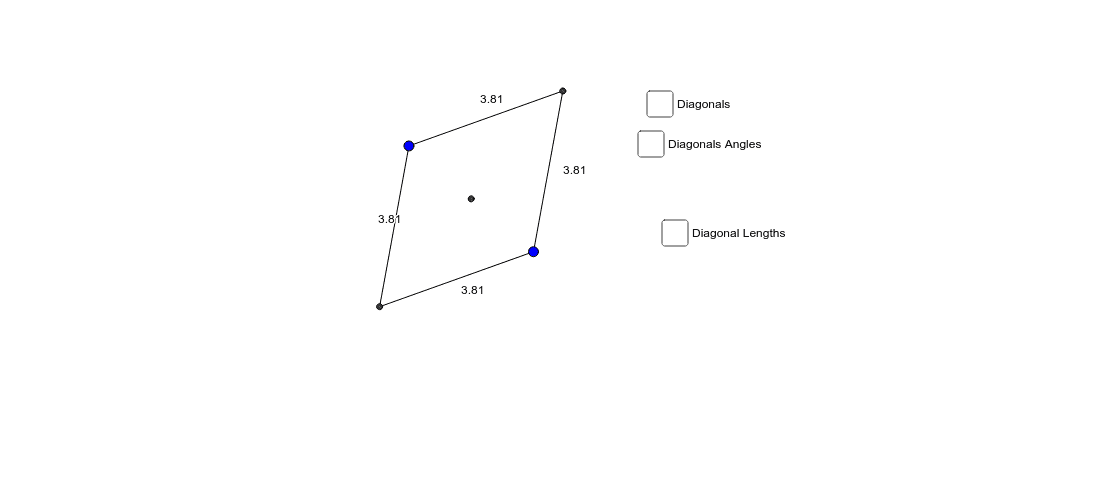
This example demonstrates the two diagonals of a rhombus and their property of being perpendicular bisectors of each other. Core mathematical concepts include the definition of a rhombus, diagonal properties, perpendicular bisectors, and angle relationships in plane geometry. Construction highlights: the GeoGebra commands Circle, Line, Intersect, Segment, and Angle are used to create vertices A, B, C, D and auxiliary points c, d, a, e, f, g, h, i, F, then construct circles, lines, intersection points, segments, and label angles α, β, γ, δ, ε, ζ, η, θ, ι, κ, λ, μ to verify the perpendicular bisector property. Suitable for middle‑school geometry instruction, high‑school plane geometry review, and geometric construction practice.
GeoGebra Commands & Parameters
Circle(A, B) → cCircle(B, A) → dLine(A, B) → aIntersect(c, d, 1) → DIntersect(c, d, 2) → ESegment(D, A) → bSegment(A, E) → eSegment(E, B) → fSegment(B, D) → gSegment(D, E) → hSegment(A, B) → iIntersect(h, i) → FAngle(A, D, F) → αAngle(F, D, B) → βAngle(F, A, D) → γAngle(D, B, F) → δAngle(E, A, F) → εAngle(E, F, B) → ζAngle(F, B, E) → ηAngle(E, A, F) → θAngle(E, A, F) → ιAngle(B, E, F) → κAngle(A, F, E) → λAngle(F, E, A) → μSegment(D, F) → kSegment(E, F) → lSegment(A, F) → mSegment(B, F) → n
AI Drawing Prompt Reference
Draw a rhombus with its two diagonals to demonstrate that the diagonals are perpendicular bisectors of each other. Start by drawing two circles of equal radius centered at two points A and B such that each circle passes through the other's center. Let the two intersection points be D and E, forming rhombus ADBE with vertices A, D, B, E. Connect adjacent vertices to complete the four sides, then draw both diagonals AB and DE, marking their intersection as F. Label the key angles at each vertex and at the intersection with Greek letters (alpha through mu) to highlight the right angles and congruent angle pairs created by the perpendicular diagonals.
The prompt above was compiled from the original drawing commands and is for reference only.