
Diagonals of a Parallelogram Bisect Each Other
Loading the math board and drawing, please wait…
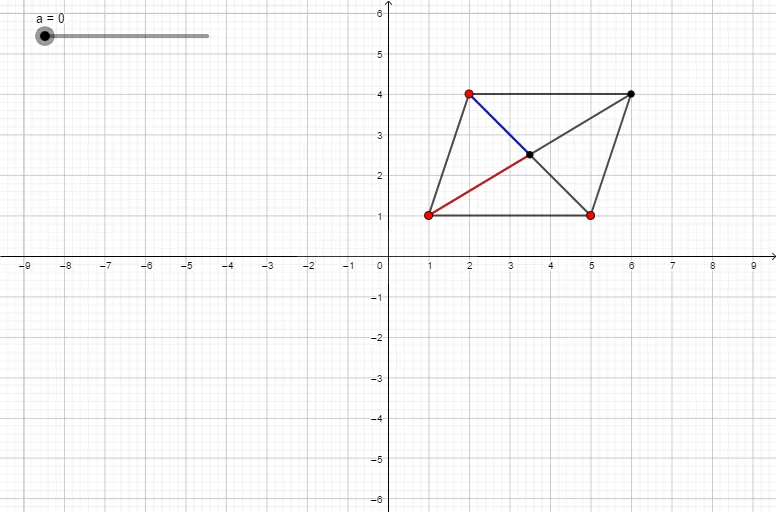
This GeoGebra example demonstrates the geometric phenomenon where the diagonals of a parallelogram bisect each other at their intersection point. Key mathematical concepts involved include the properties of parallelograms, diagonal bisection, intersection points, and fundamental geometric theorems. Construction highlights: based on the summary, it utilizes the Segment command to draw segments (such as sides and diagonals), the Line command for auxiliary lines, and the Intersect command to determine intersection points; objects include points A, B, C, D, E, and lines f, g, h, i. This example is suitable for middle school or high school geometry lessons, providing an interactive way to explore quadrilateral properties.
GeoGebra Commands & Parameters
Segment(A, B) → fSegment(A, C) → gLine(C, f) → hLine(B, g) → iIntersect(h, i) → DSegment(C, D) → jSegment(D, B) → kSegment(A, D) → lSegment(C, B) → mIntersect(l, m) → ESegment(E, Rotate[A, (a * π), E]) → nSegment(E, Rotate[C, ((-a) * π), E]) → p
AI Drawing Prompt Reference
Draw a parallelogram ABCD, connect its diagonals AC and BD which intersect at point E. Then draw diagonals DE and BE. Finally, rotate points A and C around point E to get points F and G, and connect E to F and G.
The prompt above was compiled from the original drawing commands and is for reference only.