
Diagonal Angles of a Parallelogram
Loading the math board and drawing, please wait…
In collections
Parallelograms Investigation
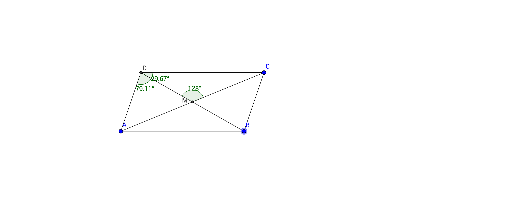
This example demonstrates the properties of diagonal angles in a parallelogram. Key concepts include angle properties and geometric construction. Using GeoGebra commands such as Line, Intersect, Segment, and Angle, a parallelogram is constructed and the diagonal angles are measured. Suitable for middle school and above students to learn geometric construction and related properties.
GeoGebra Commands & Parameters
Line(A, B) → fLine(B, C) → gLine(C, f) → hLine(A, g) → iIntersect(h, i) → DSegment(A, D) → jSegment(D, C) → kSegment(C, B) → lSegment(B, A) → mAngle(B, A, D) → αAngle(A, D, C) → βAngle(D, C, B) → γAngle(C, B, A) → δSegment(A, C) → nSegment(D, B) → pIntersect(n, p) → MDistance(D, M) → distanceDMDistance(M, B) → distanceMBDistance(A, M) → distanceAMDistance(M, C) → distanceMCAngle(C, M, D) → εAngle(M, D, C) → ζAngle(A, D, M) → η
AI Drawing Prompt Reference
Draw a parallelogram ABCD, connect the diagonals AC and BD, measure and display the intersection point M, and the four angles α, β, γ, δ formed by the diagonals. Then measure and display the distances from point M to each vertex, distanceDM, distanceMB, distanceAM, distanceMC, and the angles ε, ζ, η.
The prompt above was compiled from the original drawing commands and is for reference only.