
Determining Triangle Similarity Using Transformations
Loading the math board and drawing, please wait…
In collections
Geometry - Transformations for similarity and congruence
Geometry - Transformations for similarity and congruence
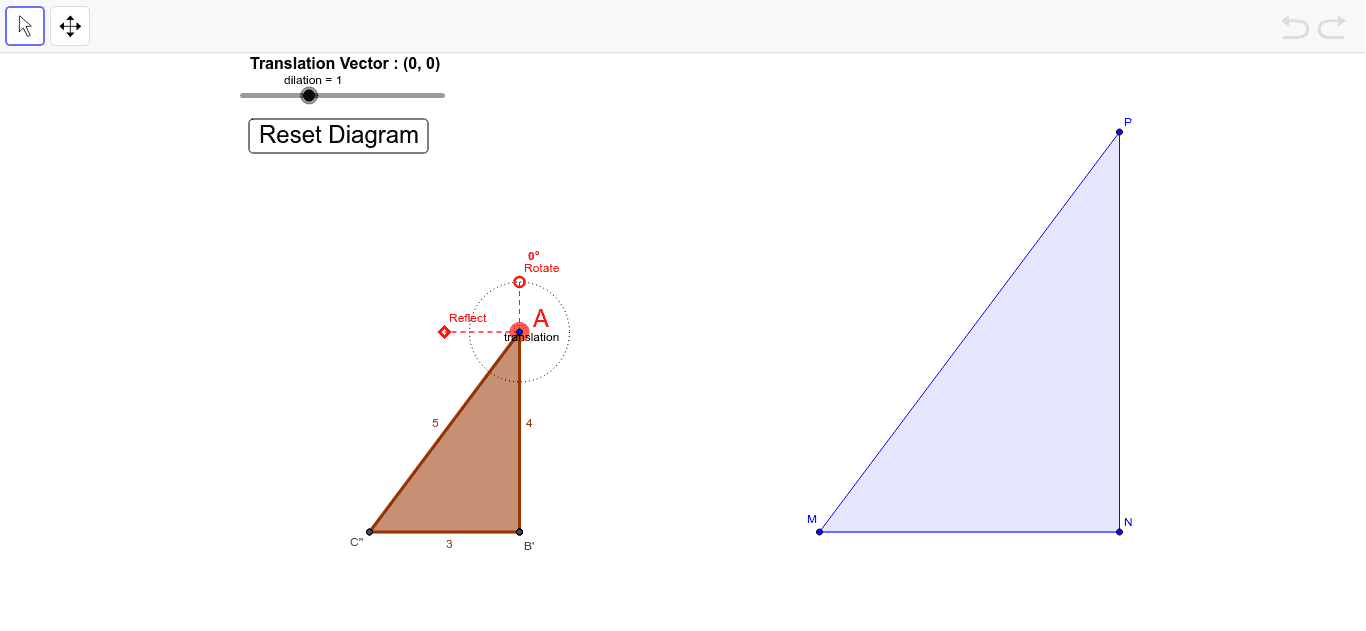
This example demonstrates how to determine if two triangles are similar using geometric transformations. It involves core mathematical concepts such as transformations (translation, rotation, reflection, dilation), and triangle similarity criteria. Key GeoGebra commands/objects used include Circle, Point, Line, Intersect, Polygon, OrthogonalLine, Segment, Dilate, Angle, and Vector. It is suitable for high school students learning the application of geometric transformations in triangle similarity determination.
GeoGebra Commands & Parameters
If(b < c, (b * 0.25), (c * 0.25)) → HandleRadiusCircle(A, HandleRadius) → dPoint(d) → RotateLine(Rotate, A) → eCircle(A, b) → fIntersect(f, e, 2) → BCircle(B, a) → gCircle(A, c) → hIntersect(g, h, 2) → CIntersect(g, h, 1) → C'Polygon(A, B, C) → poly1, c_1, a_1, b_1OrthogonalLine(A, e) → iIf(b < c, (b * 0.5), (c * 0.5)) → FlipHandleRadiusCircle(A, FlipHandleRadius) → kIntersect(k, i) → E, FSegment(F, E) → jPoint(j) → ReflectPolygon(A, B, C') → poly2, d_1, a_2, b_2Segment(Reflect, C) → lSegment(Reflect, C') → mSegment(A, Reflect) → nSegment(A, Rotate) → pPolygon(M, N, P) → poly3, p_1, m_1, n_1Dilate(A, dilation, A) → A'Dilate(B, dilation, A) → B'Dilate(C', dilation, A) → C''Polygon(A', B', C'') → poly2', c'', a', b'Dilate(A, dilation, A) → A'_1Dilate(B, dilation, A) → B'_1Dilate(C, dilation, A) → C'''Polygon(A'_1, B'_1, C''') → poly1', c'_1, a'_1, b'_1Circle(A, 0.2) → qIntersect(d, r, 1) → DAngle(Rotate, A, D) → αVector(AStartValue, A) → u
AI Drawing Prompt Reference
Draw two similar triangles ABC and A'B'C'. Start by drawing circles centered at point A with radii b and c to find points B and C, forming triangle ABC. Then, construct a perpendicular line to line segment AB through point A, finding points E and F, and connect EF. Next, draw a circle centered at point A with radius b/2 or c/2, intersecting the perpendicular line at point D, and construct angle α. Finally, perform a similarity transformation centered at point A to obtain triangle A'B'C'.
The prompt above was compiled from the original drawing commands and is for reference only.