
Determine quintic by 3 stationary points
Loading the math board and drawing, please wait…
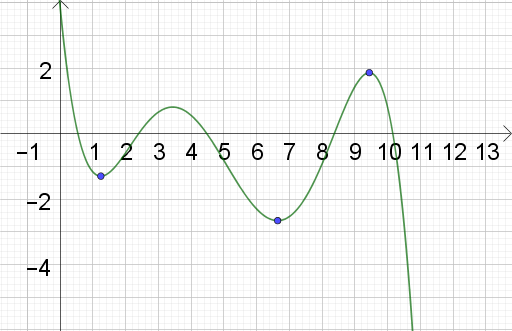
This example demonstrates how to determine a quintic polynomial function by using three stationary points. Key math concepts include polynomial functions, derivatives, coordinate geometry, and function fitting. Construction highlights involve GeoGebra commands/objects like points P_1, P_2, P_3 for defining stationary points, and variables a, b, c, d, e, f as coefficients of the quintic polynomial. Auxiliary variables A, B, C, D, E, F and ff may be used for calculations or displaying results. Suitable for high school students and above to learn polynomial properties, fitting methods, and applications of coordinate geometry, as well as for math competition or teaching demonstrations.
GeoGebra Commands & Parameters
Point P_1(1.24, -1.3)Point P_2(6.64, -2.66)Point P_3(9.44, 1.86)x(P_1)x(P_2)x(P_3)y(P_1)y(P_2)y(P_3)(((-2 * a^(4)) * e) + ((2 * a^(4)) * f) + ((2 * b^(4)) * d) - ((2 * b^(4)) * f) - ((2 * c^(4)) * d) + ((2 * c^(4)) * e) - (((4 * a) * b^(3)) * d) + (((4 * a) * b^(3)) * f) + (((4 * a) * c^(3)) * d) -(((4 * a^(5)) * e) - ((4 * a^(5)) * f) - ((4 * b^(5)) * d) + ((4 * b^(5)) * f) + ((4 * c^(5)) * d) - ((4 * c^(5)) * e) + (((5 * a) * b^(4)) * d) - (((5 * a) * b^(4)) * f) - (((5 * a) * c^(4)) * d) + ((((-2 * a^(6)) * e) + ((2 * a^(6)) * f) + ((2 * b^(6)) * d) - ((2 * b^(6)) * f) - ((2 * c^(6)) * d) + ((2 * c^(6)) * e) + (((2 * a) * b^(5)) * d) - (((2 * a) * b^(5)) * f) - (((2 * a) * c^(5)) * d) +((((-3 * a) * b^(6)) * d) + (((3 * a) * b^(6)) * f) + (((3 * a) * c^(6)) * d) - (((3 * a) * c^(6)) * e) + (((3 * b) * c^(6)) * d) - (((3 * b) * c^(6)) * e) + (((5 * a^(2)) * b^(5)) * d) - (((5 * a^(2)(((((-6 * a) * b) * c^(6)) * d) + ((((6 * a) * b) * c^(6)) * e) + ((((10 * a) * b^(2)) * c^(5)) * d) - ((((10 * a) * b^(2)) * c^(5)) * e) - ((((10 * a) * b^(5)) * c^(2)) * d) + ((((10 * a) * b^(5)) *(((a^(6) * b^(3)) * f) - ((((3 * a^(6)) * b^(2)) * c) * f) + ((((3 * a^(6)) * b) * c^(2)) * e) - ((a^(6) * c^(3)) * e) - (((3 * a^(5)) * b^(4)) * f) + ((((6 * a^(5)) * b^(3)) * c) * f) - ((((5 * a^(5)ff(x) = (A * x^(5)) + (B * x^(4)) + (C * x^(3)) + (D * x^(2)) + (E * x) + F
AI Drawing Prompt Reference
Create a coordinate plane with three given points at (1.24, -1.3), (6.64, -2.66), and (9.44, 1.86). Treat these three points as stationary points of a quintic function, and determine the quintic function that satisfies the stationary conditions at each point by using the x- and y-coordinates as constraints. Represent the quintic in standard form with six coefficients (a–f), compute the needed coefficient values by substituting the stationary-point conditions from the three points, and then plot the resulting quintic curve on the same axes. Optionally display the computed coefficient expressions or values used for the construction.
The prompt above was compiled from the original drawing commands and is for reference only.