
Determine if Two Triangles are Similar Using Transformations by Mark Hampton (2)
Loading the math board and drawing, please wait…
In collections
Geometry - Transformations for similarity and congruence
Geometry - Transformations for similarity and congruence
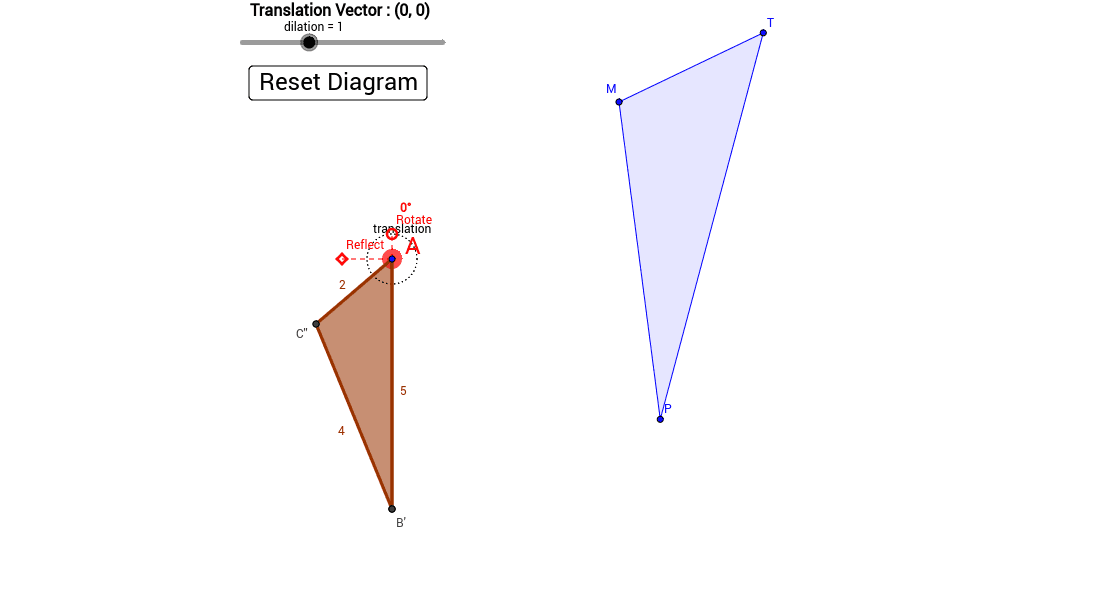
This example demonstrates how to determine if two triangles are similar using transformations. Key mathematical concepts include the properties of similar triangles and transformations. Using GeoGebra commands such as If, Circle, Point, Line, Intersect, Polygon, OrthogonalLine, Segment, Dilate, Angle, Vector, the transformation process is visually demonstrated. Suitable for students at the middle school level and above to learn about similar triangles.
GeoGebra Commands & Parameters
If(b < c, (b * 0.25), (c * 0.25)) → HandleRadiusCircle(A, HandleRadius) → dPoint(d) → RotateLine(Rotate, A) → eCircle(A, b) → fIntersect(f, e, 2) → BCircle(B, a) → gCircle(A, c) → hIntersect(g, h, 2) → CIntersect(g, h, 1) → C'Polygon(A, B, C) → poly1, c_1, a_1, b_1OrthogonalLine(A, e) → iIf(b < c, (b * 0.5), (c * 0.5)) → FlipHandleRadiusCircle(A, FlipHandleRadius) → kIntersect(k, i) → E, FSegment(F, E) → jPoint(j) → ReflectPolygon(A, B, C') → poly2, d_1, a_2, b_2Segment(Reflect, C) → lSegment(Reflect, C') → mSegment(A, Reflect) → nSegment(A, Rotate) → pPolygon(M, P, T) → poly3, p_1, m_1, n_1Dilate(A, dilation, A) → A'Dilate(B, dilation, A) → B'Dilate(C', dilation, A) → C''Polygon(A', B', C'') → poly2', c'', a', b'Dilate(A, dilation, A) → A'_1Dilate(B, dilation, A) → B'_1Dilate(C, dilation, A) → C'''Polygon(A'_1, B'_1, C''') → poly1', c'_1, a'_1, b'_1Circle(A, 0.2) → qIntersect(d, r, 1) → DAngle(Rotate, A, D) → αVector(AStartValue, A) → u
AI Drawing Prompt Reference
Draw two triangles to demonstrate their similarity through transformations. Start by drawing a circle with a center point and a radius, then draw a line connecting the center to the point on the circle. Intersect two circles of different radii with the line to get two points, and connect these points to form two triangles. Next, draw a perpendicular line from the center, intersect it with a new circle centered at the center to get two points, and connect them to form another triangle. Finally, scale one of the triangles to make it similar to the other, showing the scaling process.
The prompt above was compiled from the original drawing commands and is for reference only.