
Describing Flight Paths 1: Cones, Complex Numbers, and Polygons
Loading the math board and drawing, please wait…
In collections
Describing Flight Paths
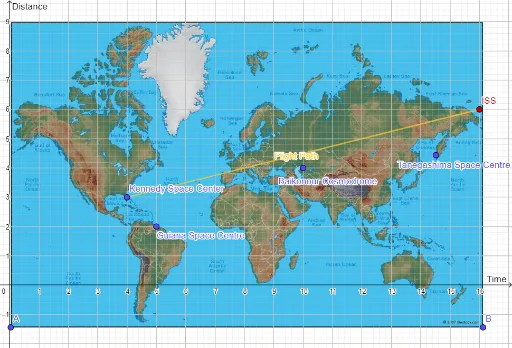
This GeoGebra example visualizes flight paths through a geometric model that integrates cones, complex numbers, polygons, and set theory. It demonstrates how a flight trajectory can be represented as a sequence of segments connecting key points (A, B, C, D, E, F, G) on a background image (pic1), using the Segment command. The core mathematical concepts include parametric representation of conic sections, complex plane operations (addition, rotation, scaling), polygon vertex dynamics, and set-theoretic relationships among path components. The construction highlights how multiple mathematical domains converge in a single interactive diagram, allowing learners to manipulate points and observe resulting path changes. Suitable for high school to undergraduate courses in analytic geometry, complex analysis, or introductory calculus, this example serves as a bridge between abstract theory and real-world applications like aviation navigation.
GeoGebra Commands & Parameters
Segment(C, G) → f