
Descartes' 1637 Multiplication Construction Part 2
Loading the math board and drawing, please wait…
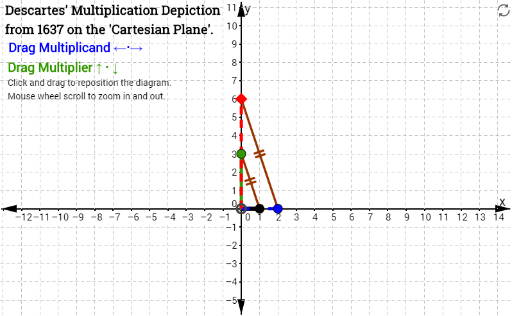
This example demonstrates Descartes' 1637 geometric method for multiplying two lengths using similar triangles and proportional relationships, visualizing the product as a segment length. Core mathematical concepts include ratio, similar triangles, vector operations, and geometric visualization of multiplication in two dimensions. Construction details: using GeoGebra commands Point, Intersect, Segment, and Line, the construction defines key points A, O, B, C, D and auxiliary segments a, b, c, d, e, f, g, with text labels text1, text2, text4, text5, text6 explaining the steps. Suitable for high school or early college students, this example helps understand the historical algebraic-geometric approach, as well as applications of vectors and proportions in geometric construction, and serves as a bridge between mathematics history and geometry teaching.
GeoGebra Commands & Parameters
Point(xAxis) → AIntersect(xAxis, yAxis) → OSegment(O, A) → aPoint(yAxis) → BSegment(O, B) → bPoint(xAxis) → CSegment(O, C) → cSegment(A, B) → dLine(C, d) → eIntersect(e, yAxis) → DSegment(C, D) → fSegment(O, D) → g
AI Drawing Prompt Reference
Draw points A and C on a straight line, and points B and O on another straight line. Connect A to O, O to B, and A to B to form a triangle. Draw a line from C intersecting the triangle at point D. Connect C to D and O to D to create auxiliary segments. Draw these lines and points to show similar triangles and proportional relationships, helping to understand multiplication in geometry.
The prompt above was compiled from the original drawing commands and is for reference only.