
Derivatives and Tangents: Dynamic Visualization of Tangent Slope
Loading the math board and drawing, please wait…
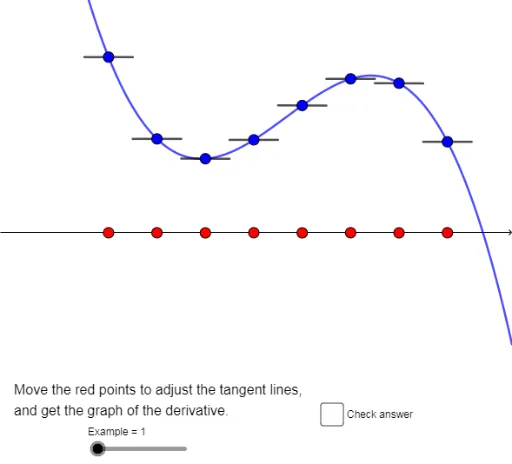
① This GeoGebra example dynamically illustrates the relationship between the derivative and the tangent line at a point on a function graph, showing how the tangent slope changes as the point moves. ② Core mathematical concepts include the geometric definition of the derivative, tangent line equations, differentiation of power functions, and the relationship between function graphs, tangents, and normals, with additional elements involving integrals and frequency distributions. ③ Construction highlights: using commands such as If, Derivative, Point, Circle, Intersect, and Segment, the applet computes the derivative function, places movable points on the curve, and draws auxiliary circles, intersection points, and tangent segments; objects include the function f, its derivative f', multiple points (A, B, C, etc.), and segments (a, b, k, etc.), forming an interactive geometric canvas. ④ Suitable for high school to early college calculus courses, this tool serves for classroom demonstrations of derivative concepts and tangent slope variation, or as an interactive exploration for students to understand the geometric meaning of derivatives.
GeoGebra Commands & Parameters
If(Example ≟ 1, (-0.02 * x^(3)) + (0.2 * x^(2)) + (0.07 * x) + 3.06, Example ≟ 2, (0.002 * x^(4)) - (0.03 * x^(3)) + (0.13 * x^(2)) + (0.15 * x) + 3.56, Example ≟ 3, (2 * cos(x)) + 6) → fDerivative(f) → f'Point(g) → JPoint(h) → KPoint(i) → LPoint(j) → MPoint(l) → NPoint(m) → OPoint(n) → PPoint(p) → QPoint(q) → RCircle(E, 1) → cIntersect(c, r) → S, TSegment(S, T) → sCircle(A, 1) → dIntersect(d, t) → U, VSegment(U, V) → eCircle(F, 1) → c_1Intersect(c_1, f_1) → W, ZSegment(W, Z) → g_1Circle(B, 1) → d_1Intersect(d_1, h_1) → A_1, B_1Segment(A_1, B_1) → i_1Circle(G, 1) → e_1Intersect(e_1, j_1) → C_1, D_1Segment(C_1, D_1) → k_1Circle(C, 1) → p_1Intersect(p_1, l_1) → E_1, F_1Segment(E_1, F_1) → m_1Circle(H, 1) → q_1Intersect(q_1, n_1) → G_1, H_1Segment(G_1, H_1) → r_1Circle(D, 1) → s_1Intersect(s_1, t_1) → I_1, J_1Segment(I_1, J_1) → a_1Circle(I, 1) → c_2Intersect(c_2, b_1) → K_1, L_1Segment(K_1, L_1) → f_2