
Derivatives and Slopes Visualizer
Loading the math board and drawing, please wait…
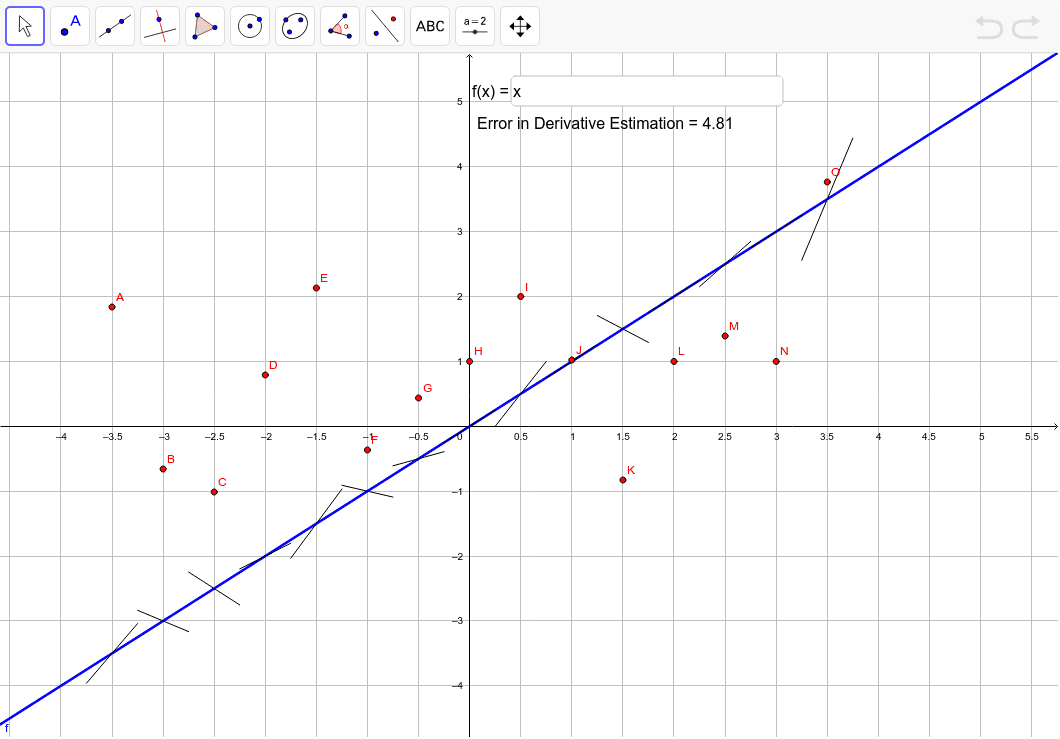
This example demonstrates how to visualize the relationship between derivatives and tangent line slopes using GeoGebra. Core mathematical concepts include the geometric meaning of derivatives (tangent slope), function analysis, and differential operations. Construction details: Use the Derivative command to compute the derivative of function f, draw tangent lines at specified points with the Line command, find intersections between curves and axes via Intersect, mark key points using Point, and enable parameter interaction through Textfield. The construction includes function f, multiple control parameters (a, b, c, etc.) and corresponding points (A series, B series, etc.), supporting dynamic observation of how tangents change as points move. Suitable for high school mathematics (introduction to derivatives) or university calculus courses, helping learners understand the physical and geometric meaning of derivatives.
GeoGebra Commands & Parameters
Line(A_2, B_2) → aLine(C_2, D_2) → bPoint(xAxis) → E_2Line(E_2, F_2) → cPoint(xAxis) → G_1Line(G_1, H_1) → dPoint(xAxis) → I_1Line(I_1, J_1) → ePoint(xAxis) → K_1Line(K_1, L_1) → gPoint(xAxis) → M_1Line(M_1, N_2) → hIntersect(xAxis, yAxis) → O_2Point(yAxis) → PLine(O_2, P) → iPoint(xAxis) → QLine(Q, R) → jLine(S, T) → kPoint(xAxis) → ULine(U, V) → lLine(W, Z) → mPoint(xAxis) → A_1Line(A_1, B_1) → nPoint(xAxis) → C_1Line(C_1, D_1) → pPoint(xAxis) → E_1Line(E_1, F_1) → qPoint(a) → APoint(b) → BPoint(c) → CPoint(d) → DPoint(e) → EPoint(g) → FPoint(h) → GPoint(i) → N_1Point(i) → O_1Line(N_1, O_1) → rPoint(i) → HPoint(j) → IPoint(k) → JPoint(l) → KPoint(m) → LPoint(n) → MPoint(p) → NPoint(q) → OSegment((x(A) + 1 / 4, f(x(A)) + y(A) / 4), (x(A) - 1 / 4, f(x(A)) - y(A) / 4)) → sSegment((x(B) + 1 / 4, f(x(B)) + y(B) / 4), (x(B) - 1 / 4, f(x(B)) - y(B) / 4)) → tSegment((x(C) + 1 / 4, f(x(C)) + y(C) / 4), (x(C) - 1 / 4, f(x(C)) - y(C) / 4)) → a_1Segment((x(D) + 1 / 4, f(x(D)) + y(D) / 4), (x(D) - 1 / 4, f(x(D)) - y(D) / 4)) → b_1Segment((x(E) + 1 / 4, f(x(E)) + y(E) / 4), (x(E) - 1 / 4, f(x(E)) - y(E) / 4)) → c_1Segment((x(F) + 1 / 4, f(x(F)) + y(F) / 4), (x(F) - 1 / 4, f(x(F)) - y(F) / 4)) → d_1Segment((x(G) + 1 / 4, f(x(G)) + y(G) / 4), (x(G) - 1 / 4, f(x(G)) - y(G) / 4)) → e_1Segment((x(H) + 1 / 4, f(x(H)) + y(H) / 4), (x(H) - 1 / 4, f(x(H)) - y(H) / 4)) → f_1Segment((x(I) + 1 / 4, f(x(I)) + y(I) / 4), (x(I) - 1 / 4, f(x(I)) - y(I) / 4)) → g_1Segment((x(J) + 1 / 4, f(x(J)) + y(J) / 4), (x(J) - 1 / 4, f(x(J)) - y(J) / 4)) → h_1Segment((x(K) + 1 / 4, f(x(K)) + y(K) / 4), (x(K) - 1 / 4, f(x(K)) - y(K) / 4)) → i_1Segment((x(L) + 1 / 4, f(x(L)) + y(L) / 4), (x(L) - 1 / 4, f(x(L)) - y(L) / 4)) → j_1Segment((x(M) + 1 / 4, f(x(M)) + y(M) / 4), (x(M) - 1 / 4, f(x(M)) - y(M) / 4)) → k_1Segment((x(N) + 1 / 4, f(x(N)) + y(N) / 4), (x(N) - 1 / 4, f(x(N)) - y(N) / 4)) → l_1Segment((x(O) + 1 / 4, f(x(O)) + y(O) / 4), (x(O) - 1 / 4, f(x(O)) - y(O) / 4)) → m_1Derivative(f, x) → p_1Textfield(f) → InputBox1