
Derivative of the Area of an Equilateral Triangle
Loading the math board and drawing, please wait…
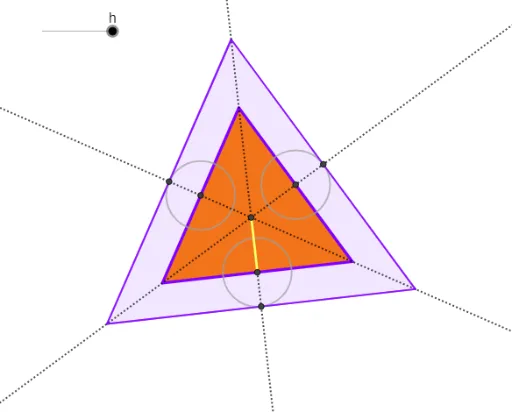
This example demonstrates the derivative of the area of an equilateral triangle, combining geometry and calculus. Key concepts include area formulas, differentiation, and geometric transformations. Construction involves GeoGebra commands like Polygon, OrthogonalLine, and Intersect. Suitable for high school students or college students learning calculus and geometric applications.
GeoGebra Commands & Parameters
Polygon(A, B, 3) → poly1, f, g, h_1, COrthogonalLine(A, g) → iOrthogonalLine(C, f) → jOrthogonalLine(B, h_1) → kIntersect(i, j) → DIntersect(g, i) → PIntersect(f, j) → JSegment(D, J) → tCircle(J, h) → cIntersect(i, g) → EIntersect(h_1, k) → FCircle(E, h) → dCircle(F, h) → eIntersect(d, i, 1) → GIntersect(e, k, 1) → HIntersect(c, j, 1) → ILine(I, f) → lLine(G, g) → mLine(H, h_1) → nIntersect(j, m) → KIntersect(i, l) → LIntersect(k, l) → MPolygon(L, M, 3) → poly2, p, q, r, N
AI Drawing Prompt Reference
Draw an equilateral triangle and calculate its area derivative with respect to side length. Start by creating an equilateral triangle, then use a perpendicular line from point A to side g to find point D. Use a perpendicular line from point C to side f to find point J, and from point B to side h1 to find point D again. Connect point D and J, and construct a circle with point J as the center, intersecting the perpendicular line i to find point E. Repeat this process to construct a circle with point E as the center, intersecting the perpendicular line i to find point G, and so on, ultimately forming a smaller triangle similar to the original one.
The prompt above was compiled from the original drawing commands and is for reference only.