
Derivative of Arccosine Function
Loading the math board and drawing, please wait…
In collections
BC Calculus
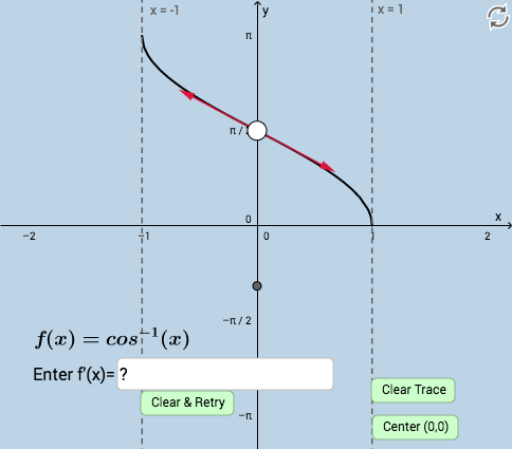
This example demonstrates the calculation process of the derivative of the arccosine function f(x) = arccos(x). Core mathematical concepts include derivatives, trigonometric functions, and geometric constructions. GeoGebra commands and objects like Point, Intersect, Circle, Tangent, Slope, Vector, and Textfield are used to construct the function graph, tangent lines, slope vectors, and related text explanations. Suitable for high school calculus learning and exploring the geometric meaning of function derivatives.
GeoGebra Commands & Parameters
Point(p) → AIntersect(i, yAxis) → BIntersect(f, i, (0, -1)) → CCircle(C, 1) → cTangent(C, f) → jIntersect(c, j, 1) → DIntersect(g, j) → ESlope(j) → mIntersect(c, j) → F, GCircle(A, 0.9642295892450196) → dTangent(A, p) → kIntersect(d, k) → H, IVector(A, I) → uVector(A, H) → vTextfield(n) → InputBox1
AI Drawing Prompt Reference
Draw the graph of the arccos(x) function and its derivative. Start by plotting the x-axis and the function curve. Then, take a point on the curve and draw the tangent line at that point. Next, draw a circle centered at this point, intersecting the tangent line at two points. Connect these points to the origin to form two vectors. Also, draw a smaller circle centered at the origin, intersect it with the tangent line at two points, and connect these points to the origin to form two more vectors. Finally, add text near the origin explaining the derivative calculation and geometric meaning.
The prompt above was compiled from the original drawing commands and is for reference only.