
Density of Sphere Packing in a Cube
Loading the math board and drawing, please wait…
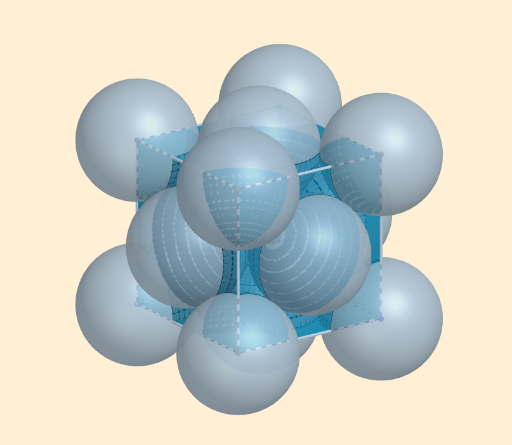
This example demonstrates the density of sphere packing in a cube. Key mathematical concepts include solid geometry and volume calculation. Using GeoGebra commands such as Surface, Translate, Point, Cube, Sphere, and Segment, a model of sphere packing within a cube is constructed. Suitable for high school or university-level solid geometry studies.
GeoGebra Commands & Parameters
Surface((sin(u) * cos(v)), (sin(u) * sin(v)), cos(u), u, 0, π / 2, v, 0, (2 * π)) → HKTranslate(Rotate[HK, 90°, xAxis], Vector[(0, sqrt(2), 0)]) → HK_1Translate(Rotate[HK, -90°, xAxis], Vector[(0, (-sqrt(2)), 0)]) → HK_2Point(Circle[B, Distance[A, B], Segment[A, B]]) → ECube(A, B, E) → a, F, FlächeEFJI, FlächeGHIJ, KanteAF, KanteAB, KanteBE, KanteEF, KanteAG, KanteFJ, KanteGJ, KanteGH, G, KanteBH, KanteHI, KanteEI, KanteIJ, H, I, J, FlächeABEF, FlächeAFJG, FlächeABHG, FlächeBEIHTranslate(Rotate[HK, 90°, yAxis], Vector[((-sqrt(2)), 0, 0)]) → HK_3Translate(Rotate[HK, -90°, yAxis], Vector[(sqrt(2), 0, 0)]) → HK_4Sphere((0, sqrt(2), 0), 1) → K_1Sphere((0, (-sqrt(2)), 0), 1) → K_2Sphere(((-sqrt(2)), 0, 0), 1) → K_3Sphere((sqrt(2), 0, 0), 1) → K_4Translate(HK, Vector[(0, 0, (-sqrt(2)))]) → HK_5Translate(Rotate[HK, 180°, yAxis], Vector[(0, 0, sqrt(2))]) → HK_6Sphere((0, 0, (-sqrt(2))), 1) → K_5Sphere((0, 0, sqrt(2)), 1) → K_6Surface((-sqrt(2)) + (sin(u) * sin(v)), (-sqrt(2)) + (sin(u) * cos(v)), (-sqrt(2)) + cos(u), u, 0, π / 2, v, 0, π / 2) → VK_1Surface((-sqrt(2)) + (sin(u) * sin(v)), (-sqrt(2)) + (sin(u) * cos(v)), sqrt(2) - cos(u), u, ((-π)) / 2, 0, v, π, (3 * π / 2)) → VK_2Surface(sqrt(2) + (sin(u) * sin(v)), (-sqrt(2)) + (sin(u) * cos(v)), sqrt(2) - cos(u), u, 0, π / 2, v, ((-π)) / 2, 0) → VK_3Surface(sqrt(2) + (sin(u) * sin(v)), (-sqrt(2)) + (sin(u) * cos(v)), (-sqrt(2)) + cos(u), u, 0, π / 2, v, ((-π)) / 2, 0) → VK_4Surface(sqrt(2) + (sin(u) * sin(v)), sqrt(2) + (sin(u) * cos(v)), (-sqrt(2)) + cos(u), u, ((-π)) / 2, 0, v, 0, π / 2) → VK_5Surface((-sqrt(2)) + (sin(u) * sin(v)), sqrt(2) + (sin(u) * cos(v)), (-sqrt(2)) + cos(u), u, ((-π)) / 2, 0, v, ((-π)) / 2, 0) → VK_6Surface(sqrt(2) + (sin(u) * sin(v)), sqrt(2) + (sin(u) * cos(v)), sqrt(2) - cos(u), u, ((-π)) / 2, 0, v, 0, π / 2) → VK_7Surface((-sqrt(2)) + (sin(u) * sin(v)), sqrt(2) + (sin(u) * cos(v)), sqrt(2) - cos(u), u, ((-π)) / 2, 0, v, ((-π)) / 2, 0) → VK_8Sphere((sqrt(2), sqrt(2), sqrt(2)), 1) → K_7Sphere(((-sqrt(2)), sqrt(2), sqrt(2)), 1) → K_8Sphere(((-sqrt(2)), (-sqrt(2)), sqrt(2)), 1) → K_9Sphere((sqrt(2), (-sqrt(2)), sqrt(2)), 1) → K_aSphere((sqrt(2), (-sqrt(2)), (-sqrt(2))), 1) → K_bSphere((sqrt(2), sqrt(2), (-sqrt(2))), 1) → K_cSphere(((-sqrt(2)), sqrt(2), (-sqrt(2))), 1) → K_dSphere(((-sqrt(2)), (-sqrt(2)), (-sqrt(2))), 1) → K_eSegment(A, A + (-1, 0, 0)) → fSegment(A, A + (0, -1, 0)) → gSegment(A, A + (0, 0, 1)) → hSegment(B, B + (0, 0, 1)) → iSegment(B, B + (0, -1, 0)) → jSegment(B, B + (1, 0, 0)) → kSegment(C, C + (-1, 0, 0)) → lSegment(C, C + (0, 1, 0)) → mSegment(C, C + (0, 0, 1)) → nSegment(E, E + (0, 0, 1)) → pSegment(E, E + (1, 0, 0)) → qSegment(E, E + (0, 1, 0)) → rSegment(G, G + (0, -1, 0)) → sSegment(H, H + (0, -1, 0)) → tSegment(G, G + (0, 0, -1)) → eSegment(G, G + (-1, 0, 0)) → f_1Segment(H, H + (1, 0, 0)) → g_1Segment(H, H + (0, 0, -1)) → h_1Segment(I, I + (0, 0, -1)) → i_1Segment(I, I + (1, 0, 0)) → j_1Segment(I, I + (0, 1, 0)) → k_1Segment(J, J + (0, 1, 0)) → l_1Segment(J, J + (0, 0, -1)) → m_1Segment(J, J + (-1, 0, 0)) → n_1