
Demonstrating the Area of a Triangle Formula
Loading the math board and drawing, please wait…
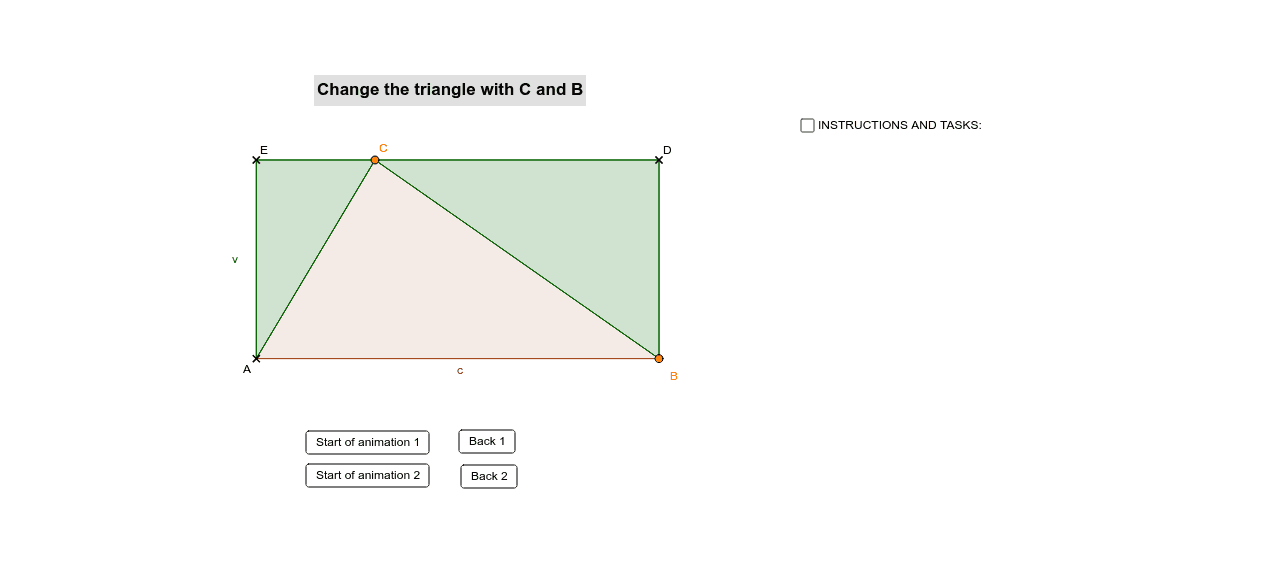
This example demonstrates the derivation of the area formula for a triangle. It visually illustrates how to construct the circumcircle of a triangle using vectors and rotation, explaining the relationship between the area formula and the circle. Key math concepts include vector operations, rotational transformations, and properties of the circumcircle. GeoGebra commands and objects like Line, Point, Polygon, Intersect, Vector, Translate, Rotate are used to construct the triangle, vectors, and rotations, providing an intuitive understanding of the area formula. Suitable for high school mathematics teaching and geometry learning, helping students grasp the geometric meaning of the formula.
GeoGebra Commands & Parameters
Line(A, xAxis) → aPoint(a) → BPolygon(A, B, C) → poly1, c, a_1, bLine(A, yAxis) → dLine(C, xAxis) → eLine(B, yAxis) → fIntersect(e, f) → DIntersect(d, e) → EPolygon(B, D, C) → poly2, c_1, b_1, d_1Polygon(A, C, E) → poly3, e_1, a_2, c_2Vector(A, C) → uDistance(A, C) → ACVector(A, U) → v_1Translate(A, v_1) → A'Translate(C, v_1) → C'Translate(E, v_1) → E'Polygon(A', C', E') → poly3', e', a', c'Rotate(A', β, A') → A''Rotate(C', β, A') → C''Rotate(E', β, A') → E''Polygon(A'', C'', E'') → poly3'', e'', a'', vVector(B, C) → wDistance(B, C) → BCVector(B, V) → v_2Translate(B, v_2) → B'Translate(D, v_2) → D'Translate(C, v_2) → C'_1Polygon(B', D', C'_1) → poly2', c'_1, b', d'Rotate(B', -γ, V) → B''Rotate(D', -γ, V) → D''Rotate(C'_1, -γ, V) → FPolygon(B'', D'', F) → poly2'', f_1, b'', d''
AI Drawing Prompt Reference
Draw a triangle and demonstrate how to construct its circumcircle using vector rotations. Start by plotting the triangle's vertices and edges, then find the circumcenter using vector operations and draw the circumcircle. Next, show the relationship between the area formula and the circumcircle by rotating and translating vectors, forming multiple rotated triangles that illustrate the geometric meaning of the formula.
The prompt above was compiled from the original drawing commands and is for reference only.