
Demonstrating Subtraction of Proper Fractions
Loading the math board and drawing, please wait…
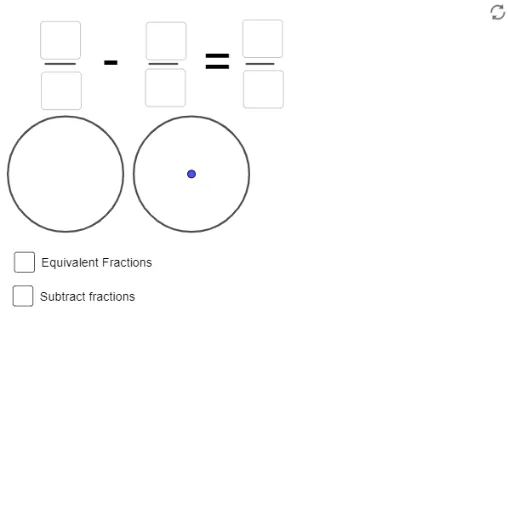
This example visually demonstrates the process and result of subtracting two proper fractions, involving core math concepts like proper fractions, common denominator, subtraction, and geometric representation. It utilizes GeoGebra commands and objects such as Point, Circle, Rotate, Vector, Segment, Textfield, Sequence, If, CommonDenominator, and Sector as outlined in the construction summary, making it suitable for middle school and above students to understand fraction subtraction and geometric intuition.
GeoGebra Commands & Parameters
Point(g) → A_1Circle(A_1, 1.5) → c_1Point(c_1) → B_1FromBase(t_{2d}, 10) → d_2FromBase(t_{2n}, 10) → n_2Rotate(B_1, ((2 * π) * n_2 / d_2), A_1) → C_1Point(h) → A_3FromBase(t_{1d}, 10) → d_1FromBase(t_{1n}, 10) → n_1Vector(A, (x(A) + 1.5, y(A))) → uTranslate(A_2, u) → B_2Rotate(B_2, (((2 * π) * n_1)) / d_1, A_2) → C_2Circle(A_2, 1.5) → c_2Translate(A, u) → BCircle(A, 1.5) → cSegment(A, B) → fRotate(B, ((2 * π) * n_1 / d_1), A) → CTextfield(t_{1n}) → InputBox1Textfield(t_{1d}) → InputBox2Sequence(Segment[Rotate[A, ((2 * π) * i / d_1), A], Rotate[B, ((2 * π) * i / d_1), A]], i, 1, d_1) → list1Textfield(t_{2n}) → InputBox3Textfield(t_{2d}) → InputBox4If(b ≟ false, Sector[c_1, B_1, C_1], If[ef ≟ true, Sector[c_1, B_1, C_1], Sector[c_1, B_1, B_1]]) → S_2Sequence(Segment[Rotate[A_1, ((2 * π) * i / d_2), A_1], Rotate[B_1, ((2 * π) * i / d_2), A_1]], i, 1, d_2) → list2CommonDenominator(f_1, f_2) → a_1If(b ≟ true, Circle[A_3, 0], Circle[A_3, 1.5]) → c_3Point(c_3) → B_3If(a_2 ≟ a_3, Sequence[Segment[Rotate[A_2, ((2 * π) * i / a), A_2], Rotate[B_2, ((2 * π) * i / a), A_2]], i, 1, a], "") → list3Rotate(B_3, (((2 * π) * n_2)) / d_2, A_3) → C_3If(a_2 ≟ a_3, Sequence[Segment[Rotate[A_3, ((2 * π) * i / a), A_3], Rotate[B_3, ((2 * π) * i / a), A_3]], i, 1, a], "") → list4If(b ≟ true, Sector[c_3, B_3, B_3], Sector[c_3, B_3, C_3]) → S_4Textfield(t_{42}) → InputBox5Textfield(t_{43}) → InputBox6Point(g_1) → DPoint(g_1) → ESegment(D, E) → iPoint(g_1) → FPoint(g_1) → GSegment(F, G) → jPoint(g_1) → HPoint(g_1) → ISegment(H, I) → j_1FromBase(t_{42}, 10) → p_2FromBase(t_{43}, 10) → p_3If(b ≟ true, Sector[c_2, B_2, B_2], Sector[c_2, B_2, C_2]) → S_3Rotate(C_2, ((-2 * π) * (f_1 - f_2)), A_2) → C_4If(b ≟ true ∧ ef ≟ true ∧ a_2 ≟ a_3, Sector[c_2, C_4, C_2]) → S_5Rotate(C, (-2 * (π * f_3)), A) → C_5Sector(c, C_5, C) → S_6If(b ≟ true, If[ef ≟ false, Sector[c, B, B], Sector[c, B, C]], Sector[c, B, C]) → S_1