
Demonstrating Pyramid Volume
Loading the math board and drawing, please wait…
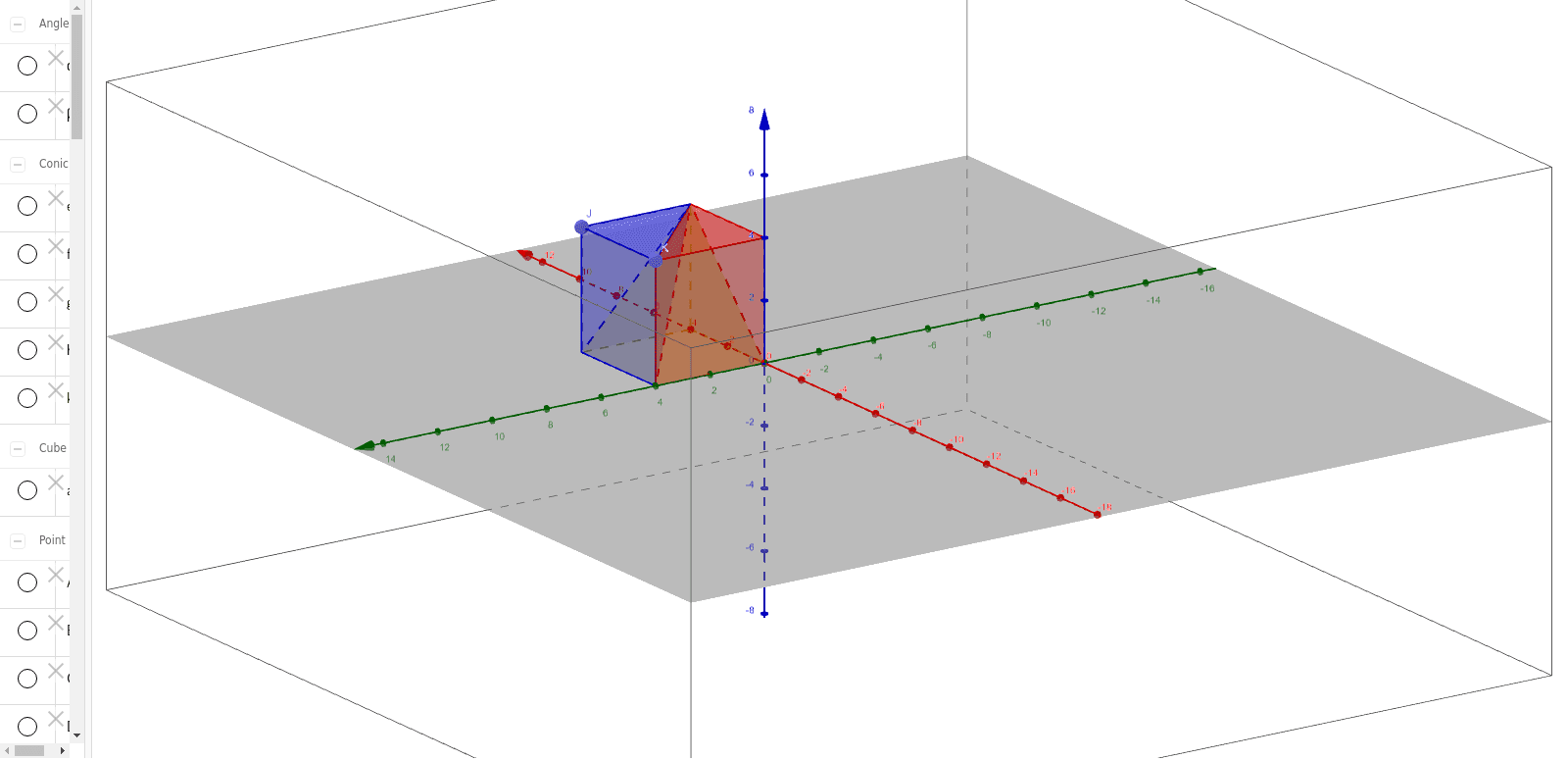
This example constructs a cube composed of three congruent pyramids to demonstrate the formula for the volume of a pyramid. Key math concepts include volume calculation, geometric proof, and spatial reasoning. GeoGebra commands used are Intersect, Point, Cube, Pyramid, Circle, Angle, Rotate. Suitable for high school students learning solid geometry volume formulas, math competitions, or enrichment activities.
GeoGebra Commands & Parameters
Intersect(yAxis, zAxis) → APoint(Circle[B, Distance[A, B], Segment[A, B]]) → DCube(A, B, D) → a, E, faceDEIH_1, faceFGHI, edgeAE_1, edgeAB_1, edgeBD_1, edgeDE_1, edgeAF_1, edgeEI_1, edgeFI_1, edgeFG_1, F, edgeBG_1, edgeGH_1, edgeDH_1, edgeHI_1, G, H, I, faceABDE_1, faceAEIF_1, faceABGF, faceBDHGPyramid(A, E, D, B, G) → b, faceABDE, edgeAG_1, edgeEG_1, edgeDG_1, edgeBG, faceAEG_1, faceDEG_1, faceBDG, faceABG, edgeAE_2, edgeDE_2, edgeBD, edgeABPyramid(A, E, I, F, G) → c, faceAEIF, edgeAG, edgeEG_2, edgeGI_1, edgeFG, faceAEG, faceEGI_1, faceFGI, faceAFG, edgeAE, edgeEI_2, edgeFI, edgeAFPyramid(I, E, D, H, G) → d, faceDEIH, edgeGI, edgeEG, edgeDG, edgeGH, faceEGI, faceDEG, faceDGH, faceGHI, edgeEI, edgeDE, edgeDH, edgeHICircle(edgeDE_1, D) → eCircle(edgeDE_1, H) → fPoint(f) → JAngle(J, D, H) → αRotate(d, (-α), edgeDE) → d'Circle(yAxis, E) → gCircle(edgeEI_1, I) → hCircle(yAxis, I) → kPoint(k) → KAngle(K, E, I) → βRotate(c, (-β), edgeAE) → c'