
Demonstrating Geometric Problems with Complementary Counting
Loading the math board and drawing, please wait…
In collections
Probability Review
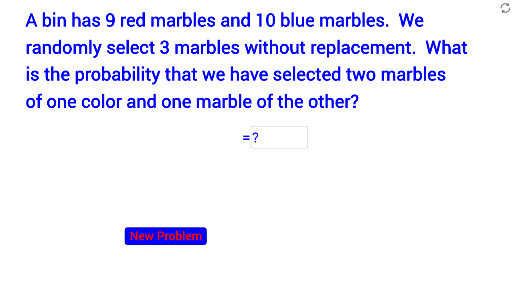
This example uses GeoGebra to demonstrate how to solve geometric problems using complementary counting. It involves core math concepts like complementary counting and probability & statistics. The construction utilizes commands and objects such as Random, Element, Textfield, RandomElement, If. Suitable for high school mathematics teaching, focusing on counting principles and probability applications.
GeoGebra Commands & Parameters
Random(1, 2) → ptypeRandom(4, 10) → bRandom(4, 10) → aElement({b^(3) / (a + b)^(3), Binomial[b, c] / Binomial[a + b, c]}, ptype) → allblueElement({a^(3) / (a + b)^(3), Binomial[a, c] / Binomial[a + b, c]}, ptype) → allredTextfield(ans) → inputBox1RandomElement({"Not Quite", "Try Again"}) → eresIf((ans - cans)^(2) < 0.001, true, false) → acorRandomElement({"Good Job", "Great!", "Way to Go!", "Awesome"}) → text5Element(sellist, ptype) → rtype