
Demonstrating Calculated Value of Pi
Loading the math board and drawing, please wait…
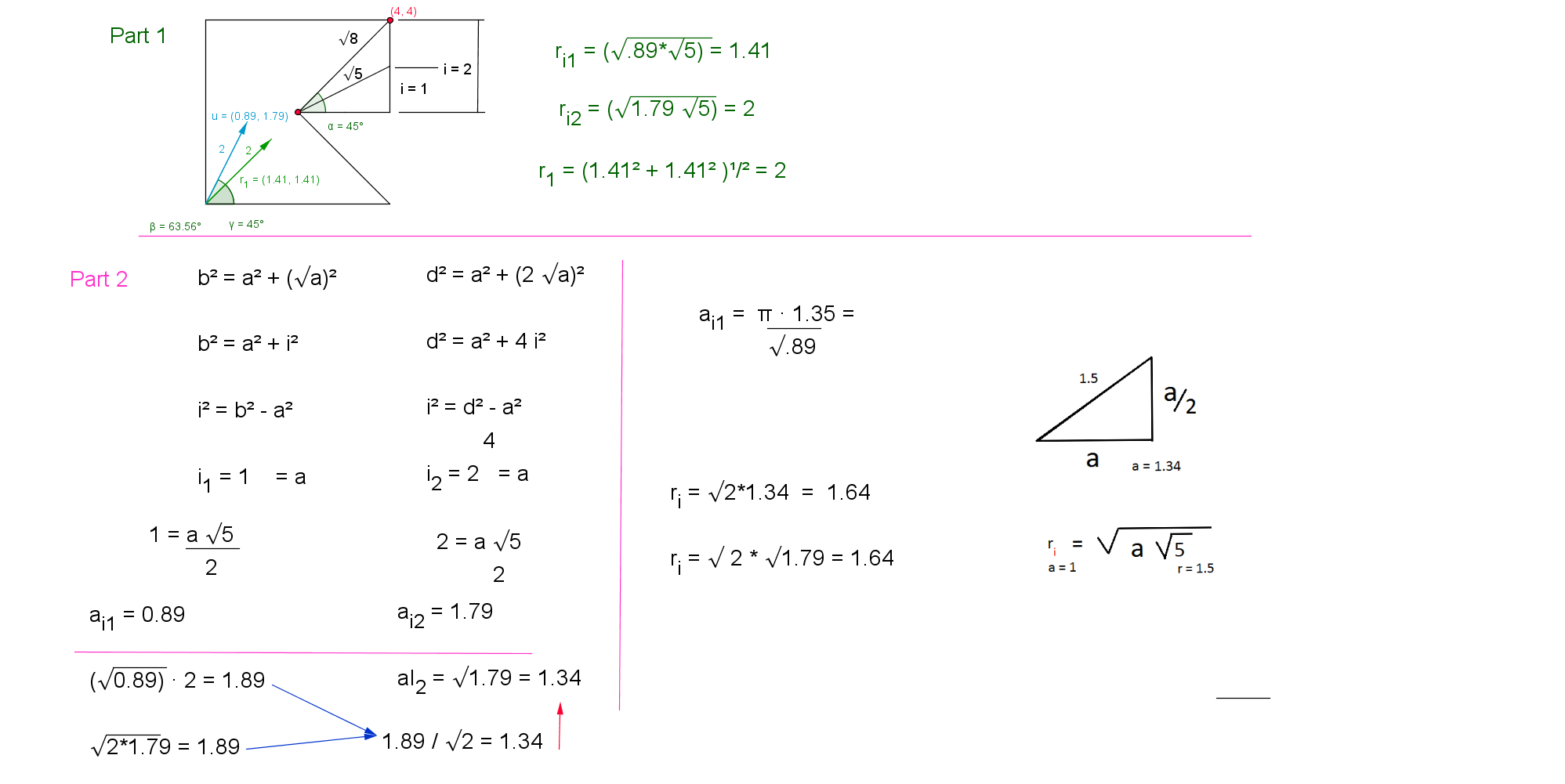
This example dynamically illustrates the calculation of Pi through semicircles, secant lines, and similarity transformations, providing an intuitive understanding of Pi's computation. Key mathematical concepts include Calculus, geometric similarity, secant lines, similarity transformations, and piecewise functions. The construction leverages GeoGebra commands such as Semicircle, Segment, Circle, Polygon, Vector, Angle, Point, Distance, Intersect, Mirror, Textfield, and Slope. It is suitable for high school and above, serving as a teaching and exploration tool for Calculus, Geometry, and Trigonometry.
GeoGebra Commands & Parameters
Semicircle(C, D) → cSemicircle(D, C) → dSegment(A, D) → aCircle(A, 1) → fSemicircle(E, F) → rSemicircle(F, E) → gPolygon(B, A, C, G) → poly1, b_1, a_1, c_1, g_1Vector((1.414213562373095, 1.414213562373095)) → u_3Vector((1.79, 0.89)) → vSegment(G, B) → eSegment(G, J) → hSegment(G, K) → iAngle(B, G, K) → α_uAngle(B, G, J) → β_vVector((0.89, 1.79)) → wSegment(G, L) → jAngle(B, G, L) → δ_wAngle(J, G, L) → Δ_vCircle(G, K) → kPoint(r) → NPoint(g) → MSegment(N, A) → pSegment(A, M) → qSegment(M, N) → sPolygon(N, C, G, B, M) → poly2, n_1, c_2, g_2, b_2, m_1Vector((2, 1)) → tVector((1, 2)) → uSegment(G, N) → d_1Segment(G, M) → e_1Angle(M, G, N) → α_tSegment(A, R) → k_1Segment(A, Q) → l_1Segment(Q, R) → p_1Circle(A, S) → q_1Distance(G, A) → distanceGAPoint(Circle[A, 3]) → TSegment(A, T) → r_1Point(Circle[G, 3]) → USegment(G, U) → s_1Point(Circle[T, 2.8284271247461903]) → VSegment(T, V) → t_1Distance(G, Q) → distanceGQDistance(G, M) → distanceGMSegment(G, M) → a_2Segment(W, Z) → d_2Vector(A_1, B_1) → u_2Vector(C_1, D_1) → v_2Distance(G, N) → distanceGNSegment(G, N) → f_2Distance(G, Q) → j_2Point(k) → E_1Point(k) → F_1Distance(F_1, E_1) → distanceF1E1Segment(E_1, F_1) → k_2Point(k_2) → G_1Point(s) → H_1Distance(G_1, H_1) → distanceG1H1Segment(G_1, H_1) → l_2Segment(I_1, J_1) → m_2Segment(K_1, L_1) → n_2Segment(K_2, L_2) → n_3Segment(K_3, L_3) → n_4Segment(K_4, L_4) → n_5Segment(K_5, L_5) → n_6Segment(K_8, L_8) → n_9Polygon(M_1, N_1, O_1, P_1) → poly3, m_3, n_{13}, o_2, p_2Intersect(k, q_1, 1) → Q_1Point(f_2) → R_1Circle(Q_1, R_1) → q_2Mirror(q_2, i) → r_2Segment(S_1, T_1) → a_3Segment(U_1, V_1) → b_3Intersect(f_3, i, 1) → W_1Point(f_3) → Z_1Segment(W_1, Z_1) → d_3Textfield(σ) → inputBox1Point(f_3) → C_2Point(f_3) → D_2Vector(G, D_2) → v_3Distance(G, D_2) → distanceGD2Vector(E_2, F_2) → w_3Mirror(N, p_1) → N'Mirror(A, p_1) → A'Segment(N', A') → p'Mirror(A, p_1) → A'_1Mirror(R, p_1) → R'Segment(A'_1, R') → g_3Mirror(A, p_1) → A'_2Mirror(M, p_1) → M'Segment(A'_2, M') → q'Mirror(A, p_1) → A'_3Mirror(Q, p_1) → Q'Segment(A'_3, Q') → h_3Segment(G, D_2) → i_3Slope(i_3) → m_4Point(p_3) → G_2Distance(G, G_2) → distanceGG2Vector(G, G_2) → j_3Segment(G, G_2) → l_3Angle(K, G, G_2) → αPoint(q_3) → H_2Point(s_3) → I_2Point(r_3) → J_2Polygon(H_2, I_2, J_2, G) → poly4, h_4, i_4, j_4, g_4Point(h_4) → M_2Point(j_4) → N_2Point(i_4) → O_2Point(g_4) → P_2Segment(O_2, M_2) → t_3Segment(N_2, P_2) → a_4Point(a_4) → Q_2Point(t_3) → R_2Segment(Q_2, R_2) → b_4Point(i_4) → T_2Point(f_4) → U_2Point(e_4) → S_2Segment(S_2, U_2) → k_4Point(p_4) → V_2Segment(G, V_2) → l_4Point(Circle[E_1, 1.35]) → W_2Segment(E_1, W_2) → q_4