
Demonstrate Addition
Loading the math board and drawing, please wait…
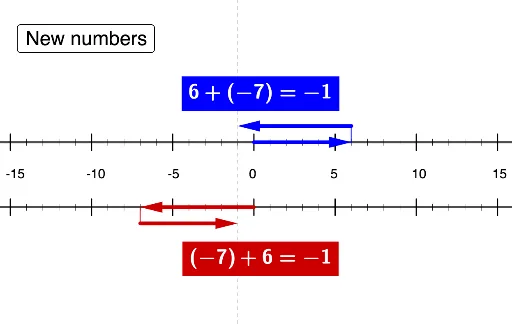
This example uses GeoGebra to demonstrate the concept of addition. It involves the core mathematical concept of addition. Using commands such as Sequence, Vector, OrthogonalLine, and Segment, a geometric model of addition is constructed. Suitable for high-grade elementary or junior high school students to learn addition.
GeoGebra Commands & Parameters
Sequence(Segment[(i, 2.2), (i, 1.8)], i, -20, 20) → L_1Sequence(Segment[(i, -2.2), (i, -1.8)], i, -20, 20) → L_2Sequence(Text[i, (i - 0.3, -0.2)], i, -20, 20, 5) → L_3Sequence(Segment[(i, 2.5), (i, 1.5)], i, -20, 20, 5) → L_4Sequence(Segment[(i, -2.5), (i, -1.5)], i, -20, 20, 5) → L_5Vector(A, B) → uVector(D, C) → vOrthogonalLine(C, xAxis) → hVector(E, F) → wVector(G, H) → aSegment(D, B) → iSegment(F, G) → j
AI Drawing Prompt Reference
Draw an addition model with 20 vertical segments from -20 to 20 at y=2.2, y=-2.2, y=2.5, and y=-2.5. Mark numbers -20 to 20 on the x-axis. Draw two vectors u and v from point A to B and point D to C. Draw a vertical line h through point C. Draw two vectors w and a from point E to F and point G to H. Draw line segments DB and FG.
The prompt above was compiled from the original drawing commands and is for reference only.