
Degree to Radian Conversion Example
Loading the math board and drawing, please wait…
In collections
CCGPS AA Unit 5 Lesson 1
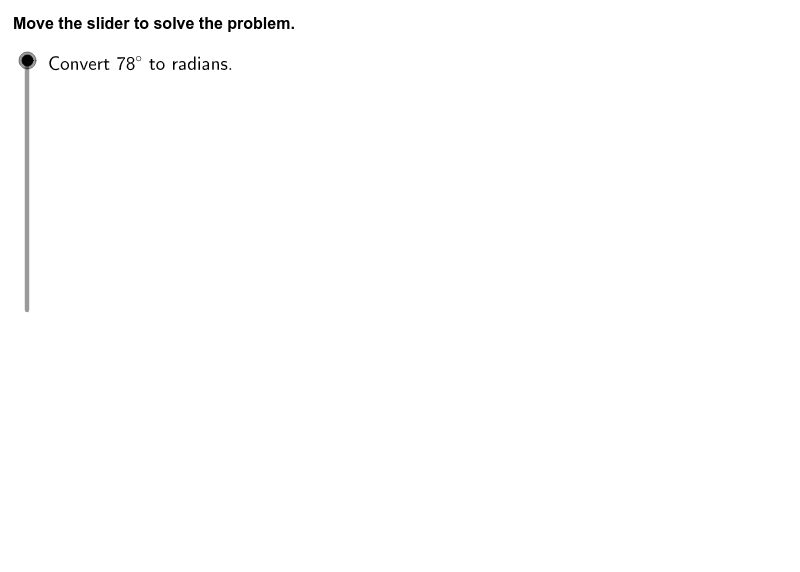
This example demonstrates how to convert 78 degrees to radians, showing both the exact and decimal approximations. It involves core math concepts like angle unit conversion and basic trigonometric formulas. The construction uses GeoGebra commands/objects such as LaTeX, GCD, stepMax, stepper, steps, counter, text elements, angleDeg, angleRad, and buttons. Suitable for high school students learning about angle-radian relationships.
GeoGebra Commands & Parameters
LaTeX(steps) → counterLaTeX("\text{Determine which conversion factor to use.}") → text1LaTeX("\text{Set up the multiplication.}") → text4LaTeX("\text{Multiply, and cancel out the degree symbols.}") → text6LaTeX((("\textcolor{#000099}{\frac{" * angleDeg) * "\pi}{180}}")) → text7GCD(angleDeg, 180) → gcfLaTeX("\text{Use your calculator to find the measure of the angle as a decimal.}") → text10LaTeX((((((("\textcolor{#000099}{\frac{" * numer) * "\pi}{") * denom) * "}\approx") * angleRad) * "}")) → text11LaTeX("\text{Use the buttons below to return to the original problem or}\cr\text{randomly generate a similar practice problem.}") → text14LaTeX((("\text{Convert " * angleDeg) * "° to radians.}")) → ProblemLaTeX((("\text{Multiply " * angleDeg) * "° by the conversion factor.}")) → text3LaTeX((((("\text{Converted to radians, the decimal measure of " * angleDeg) * "° is}\cr\text{approximately ") * angleRad) * " radians.}")) → text12LaTeX((((("\text{Recall that radians compare the value of the arc length to the value of}\cr\text{the radius; therefore, for this " * angleDeg) * "° angle, the arc length is approximately}\cr\text{") * angleRad) * " times the length of the radius.}")) → text13LaTeX("\text{Reduce the fraction, if possible.}") → text8LaTeX("\text{Recall that }\pi\text{ radians = 180°. Thus, }\frac{\pi\text{ }radians}{180°}\text{ = 1, since dividing}\cr\text{one quantity by its equivalent is equal to 1. Since degrees need to be}\cr\text{converted to radians, multiply by }\frac{\pi}{180°}\text{ so that the degrees in the}\cr\text{denominator will cancel out and radians will remain.}") → text2LaTeX((((((((((("\text{The greatest common factor of }\textcolor{#000099}{" * angleDeg) * "}\text{ and }\textcolor{#000099}{180}\text{ is }\textcolor{#000099}{") * gcf) * "}\text{, so the reduced}\cr\text{form of the exact measure of }\textcolor{#000099}{") * angleDeg) * "°}\text{ in radians is }\textcolor{#000099}{\frac{") * numer) * "\pi}{") * denom) * "}}.")) → text9LaTeX((("\textcolor{#000099}{" * angleDeg) * "^{\circ}\bullet\frac{\pi}{180^{\circ}}}")) → text5
AI Drawing Prompt Reference
Create a math illustration showing the conversion of 78 degrees to radians. Include text steps like 'Determine the conversion factor,' 'Set up multiplication,' and 'Multiply and cancel degree symbols.' Display the exact radian value using π and the decimal approximation. Show the angle unit conversion formula, with buttons to return to the original problem or generate a similar one. Note that π radians equals 180 degrees and explain the relationship between arc length and radius.
The prompt above was compiled from the original drawing commands and is for reference only.