
Definition of a Trapezoid
Loading the math board and drawing, please wait…
In collections
Properties of Trapezoids and Kites
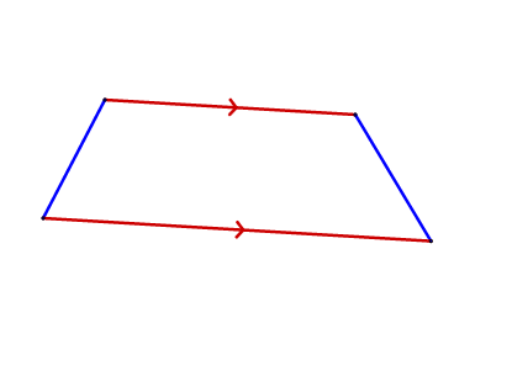
This GeoGebra example dynamically illustrates the definition of a trapezoid, showing a quadrilateral with one pair of parallel sides and the other pair non-parallel. The core mathematical concept is the criterion for identifying a trapezoid, involving parallel lines, segments, vertices, and basic quadrilateral properties, with extensions to isosceles and right trapezoids. Construction highlights: the Segment command creates the sides, the Line command constructs parallel lines, and the Point command marks vertices A, B, C, D, while auxiliary lines f, g, h, i, j verify the parallel relationships; dragging vertices reveals how the shape changes. This is suitable for middle school geometry lessons or self-study, helping students intuitively grasp the trapezoid definition and distinguish it from parallelograms and rectangles.
GeoGebra Commands & Parameters
Segment(A, B) → fSegment(A, C) → gLine(C, f) → hPoint(h) → DSegment(B, D) → iSegment(C, D) → j
AI Drawing Prompt Reference
Draw a trapezoid with one pair of parallel sides and one pair of non-parallel sides. Start by drawing points A and B, then draw a line segment g connecting A and C. Next, draw a line h through C that is parallel to g, and find the other vertex D on this line. Finally, draw line segments i connecting B and D, and j connecting C and D.
The prompt above was compiled from the original drawing commands and is for reference only.