
Decorated Polygons
Loading the math board and drawing, please wait…
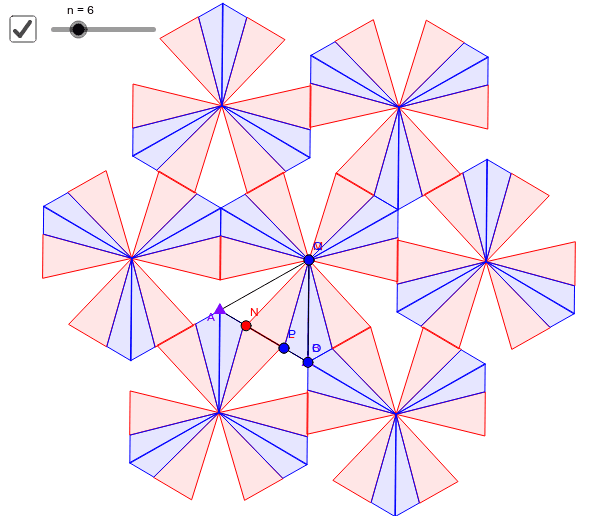
This example demonstrates the construction of decorative polygon patterns by transforming a triangle into a regular 2n-gon and applying alternating flips and rotations. It involves core mathematical concepts like polygon transformations, symmetry, and geometric constructions. Key GeoGebra commands and objects used include Polygon, Intersect, Point, PointIn, Sequence, Mirror, Midpoint, Rotate, PolyLine, and Translate. Suitable for high school mathematics education to understand transformations and tessellations.
GeoGebra Commands & Parameters
Polygon(A, B, n) → poly1, f, q, s, t, C, D, F, G, H, I, J, g, K, S, T, h, i, j, k, l, m, pIntersect(Ray[Rotate[A, (180° - (360 * ° / n)) / 2, A], Rotate[B, (180° - (360 * ° / n)) / 2, A]], Ray[Rotate[B, ((-(180° - (360 * ° / n)))) / 2, B], Rotate[A, ((-(180° - (360 * ° / n)))) / 2, B]]) → EPoint(Polygon[A, B, E]) → LPoint(Polygon[A, B, E]) → MPoint(Polygon[A, B, E]) → NPolygon(L, M, N) → poly2, n_1, l_1, m_1PointIn(Polygon[A, B, E]) → OPointIn(Polygon[A, B, E]) → PPointIn(Polygon[A, B, E]) → QPolygon(O, P, Q) → poly3, q_1, o, p_1Sequence(Polygon[Rotate[L, ((i * 720) * ° / n), E], Rotate[M, ((i * 720) * ° / n), E], Rotate[N, ((i * 720) * ° / n), E]], i, 1, n / 2) → list1Sequence(Polygon[Rotate[O, ((i * 720) * ° / n), E], Rotate[P, ((i * 720) * ° / n), E], Rotate[Q, ((i * 720) * ° / n), E]], i, 1, n / 2) → list2Mirror(list1, Line[A, E]) → list1'Mirror(list2, Line[A, E]) → list2'Midpoint(A, B) → RRotate(L, 180°, R) → L'Rotate(M, 180°, R) → M'Rotate(N, 180°, R) → N'Rotate(O, 180°, R) → O'Rotate(P, 180°, R) → P'Rotate(Q, 180°, R) → Q'Mirror(list1', Line[C, B]) → list1''Mirror(list2', Line[C, B]) → list2''Rotate(list1, 180°, R) → list1'_1Rotate(list2, 180°, R) → list2'_1PolyLine(A, B, E, A) → rMirror(E, Line[A, B]) → E'Mirror(list1'_1, Line[E', B]) → list5Mirror(list2'_1, Line[E', B]) → list7Translate(Rotate[{list1, list1'}, (-360 * ° / n), A], A - B) → list9Translate(Rotate[{list2, list2'}, (-360 * ° / n), A], A - B) → list10Sequence(Rotate[list9, (((i * 360))° * (1 + a) / n), E], i, 1, n / (1 + a)) → list11Sequence(Rotate[list10, (((i * 360))° * (1 + a) / n), E], i, 1, n / (1 + a)) → list12Sequence(Rotate[list1'_1, (((i * (1 + a)) * 360) * ° / n), E], i, 1, n / (1 + a)) → list3Sequence(Rotate[list5, (((i * (1 + a)) * 360) * ° / n), E], i, 1, n / (1 + a)) → list6Sequence(Rotate[list2'_1, (((i * (1 + a)) * 360) * ° / n), E], i, 1, n / (1 + a)) → list4Sequence(Rotate[list7, (((i * (1 + a)) * 360) * ° / n), E], i, 1, n / (1 + a)) → list8Mirror(list2, U) → list2'_2Mirror(list2', U) → list2''_1Mirror(list1', U) → list1''_1Mirror(list1, U) → list1'_2Sequence(Rotate[{list2''_1, list2'_2}, (((i * (1 + a)) * 360) * ° / n), E], i, 1, n / (1 + a)) → list13Sequence(Rotate[{list1''_1, list1'_2}, (((i * (1 + a)) * 360) * ° / n), E], i, 1, n / (1 + a)) → list14