
De Morgan's Law by Geometric Construction
Loading the math board and drawing, please wait…
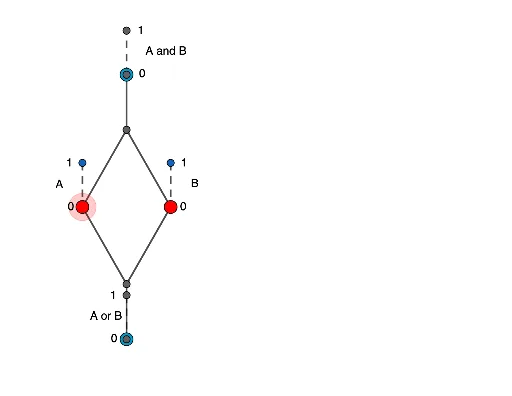
This example demonstrates De Morgan's Law through geometric construction. De Morgan's Law is a fundamental theorem in logic, involving operations on set complements. By constructing geometric figures, we can visually understand these logical operations. The example uses GeoGebra commands such as Segment, Mirror, Point, Circle, and Intersect. Suitable for high school mathematics education, it helps students understand the relationship between logic and set theory.
GeoGebra Commands & Parameters
Segment(A, B) → fMirror(A, yAxis) → A'Mirror(B, yAxis) → B'Segment(A', B') → f'Point(f) → CPoint(f') → DCircle(C, arm1) → cCircle(D, arm1) → dIntersect(c, d, 2) → ECircle(E, arm2) → eIntersect(e, yAxis, 2) → GIntersect(c, d, 1) → HCircle(H, arm2) → gIntersect(g, yAxis, 1) → ICircle(B, arm1) → hMirror(h, yAxis) → h'Intersect(h, h', 1) → JCircle(J, arm2) → kIntersect(k, yAxis, 1) → KCircle(K, 4) → pIntersect(p, yAxis, 2) → LIntersect(h, h', 2) → MCircle(M, arm2) → qIntersect(q, yAxis, 2) → NCircle(N, 4) → rIntersect(r, yAxis, 2) → OSegment(D, H) → iSegment(C, H) → jSegment(H, I) → lSegment(D, E) → mSegment(C, E) → nSegment(E, G) → sSegment(N, O) → tSegment(L, K) → a