
Damped Motion of a Spring
Loading the math board and drawing, please wait…
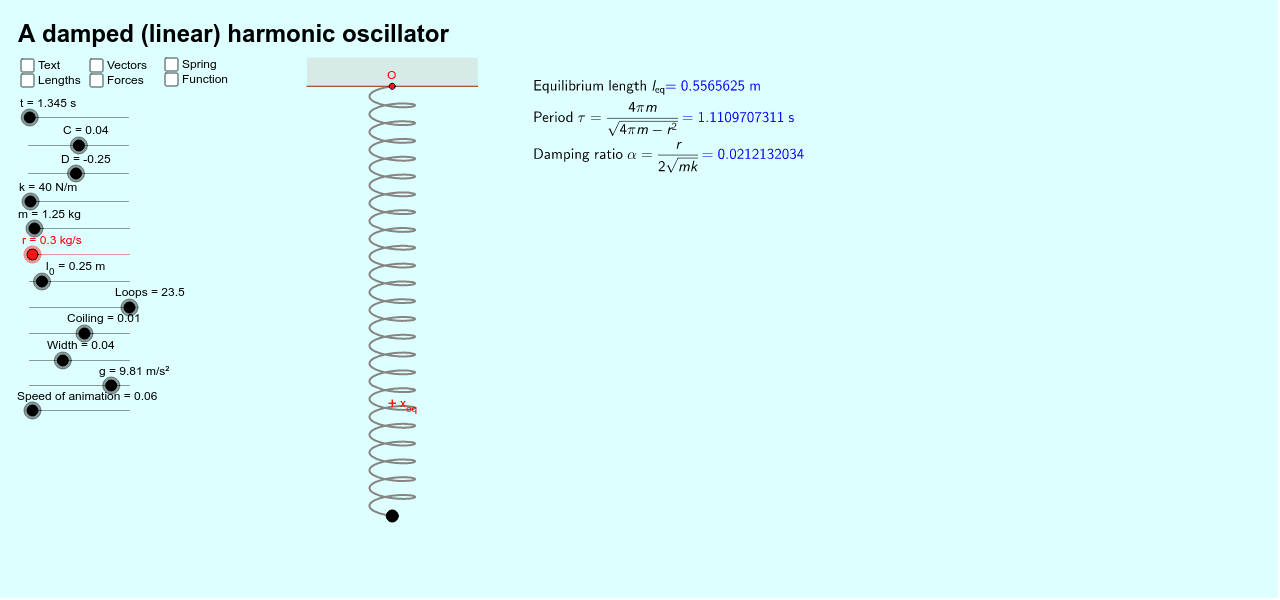
This example demonstrates the damped motion of a spring according to the linear damping model. Key mathematical concepts include differential equations and functions. Using GeoGebra commands such as Intersect, Vector, and CurveCartesian, the vibration curve can be constructed. Suitable for high school physics and mathematics courses.
GeoGebra Commands & Parameters
Intersect(xAxis, yAxis) → OPoint(Circle[O, abs(l_{eq})]) → x_{eq}Intersect(fff, yAxis, 1) → PVector(I, I') → iMirror(O', O) → O''Mirror(O'''', yAxis) → O'''Polygon(O', O'', O''', O'''') → Ceiling, o, o', o'', o'''Segment(O, P) → SpringMidpoint(O, P) → SVector(S, S') → sPoint(o) → E''Point(o) → EIntersect(fff, Line[E, yAxis]) → E'Midpoint(E, E') → MVector(M, E) → jVector(M, E') → j'Midpoint(E'', E''') → M'Vector(M', E'') → uVector(M', E''') → u'Vector(P, W') → wIf(v' ≥ 0, (x(P), y(P) + (sgn(v') * 0.1)), (x(W'), y(W') + (sgn(v') * 0.1))) → HVector(P, H) → hVector(P, R') → RCurveCartesian(((-Width) * sin(t)), ((Spring - (2 * Coiling)) * t / (((2 * π) * Loops))) - (Coiling * (cos(t) - 1)) + y(P), t, 0, ((2 * π) * Loops)) → Coil