
Cylinder with Maximum Volume
Loading the math board and drawing, please wait…
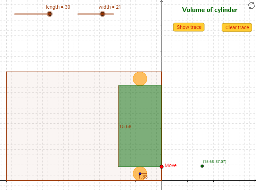
This example demonstrates how to cut a piece of paper or cardboard to form a cylinder with the maximum volume. It involves core mathematical concepts such as volume calculation, optimization problems, and geometric construction. Key GeoGebra commands and objects used include Intersect, Point, Distance, If, Polygon, LineBisector, Mirror, Line, Circle, Midpoint, OrthogonalLine, Segment, Length, and Cylinder. Suitable for high school students studying solid geometry and calculus to understand real-world optimization problems.
GeoGebra Commands & Parameters
Intersect(xAxis, yAxis) → BPoint(Segment[(0, If[MaxPromj_b ≥ MaxPromj_a, MaxPromj_a, MaxPromj_b]), B]) → P_1Distance(B, P_1) → PromjIf(Promj / 2 ≥ 2, 1, If[1.5 ≤ Promj / 2 < 2, 0.8, If[1 ≤ Promj / 2 < 1.5, 0.6, If[0.5 ≤ Promj / 2 < 1, 0.4, 0.2]]]) → bElipsaPolygon(A, B, C, D) → mnogokut1, a, b, c, dLineBisector(b) → gMirror(P_1, g) → P_1'Line(P_1', xAxis) → fLine(P_1, xAxis) → h_1Circle(P_1, o_B) → eIntersect(e, h_1, 1) → ECircle(P_1', o_B) → kIntersect(k, f, 1) → FPolygon(P_1, P_1', F, E) → P, p, p', f_1, e_1Midpoint(Segment[P_1', F]) → GMidpoint(Segment[E, P_1]) → HOrthogonalLine(G, xAxis) → iCircle(G, Promj / 2) → qIntersect(q, i, 2) → ICircle(H, Promj / 2) → rIntersect(r, i, 1) → JCircle(I, G) → sCircle(J, H) → tLine(J, xAxis) → jIntersect(t, j, 2) → KSegment(J, K) → lLength(f_1) → hCircle(U, Promj / 2, xOyPlane) → p_1OrthogonalLine(U, xOyPlane) → m_1Cylinder(p_1, h) → u, t_1, vSegment(W, U) → m
AI Drawing Prompt Reference
Draw a rectangular piece of cardboard. Place a movable point on one side, whose position is determined by a ratio. Using this point and a rectangle vertex, construct two semicircles via symmetry and circles, then connect them to form the lateral surface net of a cylinder. Mark midpoints on the net, draw perpendicular lines, and intersect circles to locate the base circle's center and radius. Finally, draw the base circle and extrude it vertically to form a cylinder, adding a height segment.
The prompt above was compiled from the original drawing commands and is for reference only.