
Cyclic Quadrilateral Properties Demo
Loading the math board and drawing, please wait…
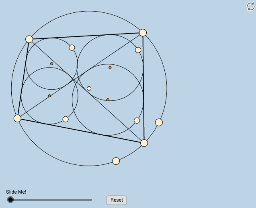
This example demonstrates the properties of cyclic quadrilaterals, focusing on the Japanese Theorem for Cyclic Quadrilaterals. It involves core concepts like circles, inscribed quadrilaterals, angle bisectors, sine rule, and geometric transformations. The construction utilizes commands such as Circle, Point, Rotate, Segment, Dilate, Vector, Ray, Polygon, AngularBisector, Intersect, OrthogonalLine, Min, CircleSector, Translate, Line, Midpoint, and Angle. It is suitable for high school and above students to understand the geometric properties and applications of cyclic quadrilaterals and related theorems.
GeoGebra Commands & Parameters
Circle(A, B) → cPoint(c) → CRotate(C, 2°, A) → C'CircleArc(A, C', C) → dPoint(d) → DCircleArc(A, D, C) → ePoint(e) → ECircleArc(A, E, C) → fPoint(f) → FCircleArc(A, F, C) → gPoint(g) → GSegment(D, E) → bSegment(E, F) → hSegment(D, G) → aSegment(G, F) → iCircle(A, B) → e_1Dilate(E, If[0 < j ≤ 1, 1 - j, 0], G) → E'Vector(E, E') → uRay(D, G) → lPoint(l) → PDilate(F, If[2 < j ≤ 3, 3 - j, 0], D) → F'Vector(F, F') → vRay(G, D) → nPoint(n) → QPolygon(G, D, E, F) → poly1, g_2, d_2, e_2, f_2Segment(G, E) → mSegment(D, F) → sDilate(F, If[0 < j ≤ 1, 1 - j, 0], D) → F'_1Segment(F, F'_1) → i_1AngularBisector(E, F, D) → kAngularBisector(E, D, F) → pIntersect(k, p) → HOrthogonalLine(H, h) → qIntersect(q, h) → IAngularBisector(F, D, G) → rAngularBisector(G, F, D) → tIntersect(r, t) → JOrthogonalLine(J, i) → f_1Intersect(f_1, i) → KAngularBisector(E, F, G) → g_1AngularBisector(G, E, F) → h_1Intersect(g_1, h_1) → LOrthogonalLine(L, h) → j_1Intersect(j_1, h) → MAngularBisector(E, G, D) → k_1AngularBisector(G, E, D) → l_1Intersect(k_1, l_1) → NRotate(I, If[1 < j ≤ 2, (((j - 1) * 2) * π), (2 * π)], H) → J'CircleArc(H, I, J') → c_1Circle(H, I) → d_1Rotate(K, If[2 < j ≤ 3, (((j - 2) * 2) * π), (2 * π)], J) → K'CircleArc(J, K, K') → p_1Circle(J, K) → q_1Dilate(G, If[3 < j ≤ 4, 4 - j, 0], E) → G'Segment(G, G') → m_1Rotate(M, If[4 < j ≤ 5, (((j - 4) * 2) * π), (2 * π)], L) → M'CircleArc(L, M, M') → r_1Circle(L, M) → s_1OrthogonalLine(N, a) → n_1Intersect(n_1, a) → ORotate(O, If[5 < j ≤ 6, (((j - 5) * 2) * π), (2 * π)], N) → O'CircleArc(N, O, O') → t_1Circle(N, O) → c_2Dilate(N, If[6 < j ≤ 7, 7 - j, 0], H) → N'Segment(N, N') → a_1Segment(H, N) → b_1Segment(H, L) → h_2Min({b_1, h_2}) → oCircle(H, (0.3 * o)) → k_2Intersect(k_2, c, 1) → RIntersect(k_2, c, 1) → SIntersect(c, h_2) → T,Intersect(k_2, h_2) → U,Intersect(k_2, b_1) → V,CircleSector(H, U, V) → p_2Dilate(H, If[8 < j ≤ 9, 9 - j, 0], L) → H'Segment(H, H') → i_2Dilate(N, If[7 < j ≤ 8, 8 - j, 0], J) → N'_1Vector(N, N'_1) → w_2Translate(N, w_2) → N'_2Translate(N', w_2) → N''Segment(N'_2, N'') → j_2Dilate(H, If[9 < j ≤ 10, 10 - j, 0], N) → H'_1Vector(H, H'_1) → u_1Translate(H, u_1) → H'_2Translate(H', u_1) → H''Segment(H'_2, H'') → l_2Polygon(J, N, H, L) → poly2, j_3, n_2, h_3, l_3Dilate(H, If[11 < j ≤ 12, 12 - j, 0], L) → H'_3Vector(H, H'_3) → v_1Translate(p_2, v_1) → q_2Rotate(q_2, If[12 < j ≤ 13, ((j - 12) * π / 2), π / 2], L) → r_2Dilate(L, If[13 < j ≤ 14, 14 - j, 0], J) → L'Vector(L, L') → w_1Translate(r_2, w_1) → s_2Rotate(s_2, If[14 < j ≤ 15, ((j - 14) * π / 2), π / 2], J) → t_2Dilate(J, If[15 < j ≤ 16, 16 - j, 0], N) → J'_1Vector(J, J'_1) → u_2Translate(t_2, u_2) → c_3Rotate(c_3, If[16 < j ≤ 17, ((j - 16) * π / 2), π / 2], N) → d_3Point(d_1) → WPoint(s_1) → ZPoint(q_1) → A_1Point(c_2) → B_1Dilate(H, If[0 < w < 1, 1 - w, 0], W) → H'_4Dilate(L, If[0 < w < 1, 1 - w, 0], Z) → L'_1Dilate(J, If[0 < w < 1, 1 - w, 0], A_1) → J'_2Dilate(N, If[0 < w < 1, 1 - w, 0], B_1) → N'_3Segment(H, W) → m_2Segment(L, Z) → a_2Segment(J, A_1) → b_2Segment(N, B_1) → f_3Intersect(c, g_3) → D_1, E_1OrthogonalLine(A, g_3) → i_3Intersect(c, i_3) → C_1, G_1Line(C_1, g_3) → k_3Line(G_1, g_3) → m_3Midpoint(F_1, E_1) → H_1Line(H_1, i_3) → n_3Line(F_1, i_3) → p_3Line(N, i_3) → t_3Segment(H, H'_4) → a_3Segment(L, L'_1) → b_3Segment(J, J'_2) → e_3Segment(N, N'_3) → f_4Circle(H_1, o_1 / 2) → c_4Circle(F_1, o_1 / 2) → d_4Intersect(c_4, n_3, 2) → M_1Intersect(d_4, p_3, 2) → N_1Intersect(c_4, n_3, 1) → O_1Intersect(d_4, p_3, 1) → P_1Segment(O_1, M_1) → g_4Line(L, t_3) → q_3Line(J, t_3) → r_3Line(H, t_3) → s_3Point(s_3) → I_1Point(q_3) → J_1Point(r_3) → K_1Point(t_3) → Q_1Angle(B_1, N, Q_1) → αAngle(W, H, I_1) → βAngle(Z, L, J_1) → γAngle(A_1, J, K_1) → δCircle(P_1, f_4) → e_4Intersect(e_4, p_3, 2) → L_1Circle(O_1, e_3) → h_4Intersect(h_4, n_3, 2) → R_1Dilate(P_1, If[1 < w < 2, 2 - w, 0], L_1) → S_1Dilate(O_1, If[1 < w < 2, 2 - w, 0], R_1) → T_1Dilate(L_1, If[2 < w < 3, 3 - w, 0], N_1) → U_1Dilate(R_1, If[2 < w < 3, 3 - w, 0], M_1) → V_1Segment(P_1, S_1) → i_4Segment(S_1, U_1) → j_4Segment(O_1, T_1) → k_4Segment(T_1, V_1) → l_4Dilate(N, If[4 < w < 5, 5 - w, 0], P_1) → N'_4Vector(N, N'_4) → v_2Translate(N, v_2) → N'_5Translate(N'_3, v_2) → W_1Segment(N'_5, W_1) → m_4Rotate(N'_5, If[4 < w ≤ 5, ((w - 4) * α), α], N'_5) → Z_1Rotate(W_1, If[4 < w ≤ 5, ((w - 4) * α), α], N'_5) → A_2Segment(Z_1, A_2) → n_4Dilate(L, If[5 < w < 6, 6 - w, 0], S_1) → L'_2Vector(L, L'_2) → u_3Translate(L, u_3) → L'_3Translate(L'_1, u_3) → B_2Segment(L'_3, B_2) → p_4Rotate(L'_3, If[5 < w ≤ 6, ((w - 5) * γ), γ], L'_2) → C_2Rotate(B_2, If[5 < w ≤ 6, ((w - 5) * γ), γ], L'_2) → D_2Segment(C_2, D_2) → q_4Dilate(J, If[6 < w < 7, 7 - w, 0], O_1) → J'_3Vector(J, J'_3) → v_3Translate(J, v_3) → J'_4Translate(J'_2, v_3) → E_2Segment(J'_4, E_2) → r_4Rotate(J'_4, If[6 < w ≤ 7, ((w - 6) * δ), δ], J'_3) → G_2Rotate(E_2, If[6 < w ≤ 7, ((w - 6) * δ), δ], J'_3) → H_2Segment(G_2, H_2) → s_4Dilate(H, If[7 < w ≤ 8, 8 - w, 0], T_1) → H'_5Vector(H, H'_5) → w_3Translate(H, w_3) → H'_6Translate(H'_4, w_3) → I_2Segment(H'_6, I_2) → t_4Rotate(H'_6, If[7 < w ≤ 8, ((w - 7) * β), β], H'_5) → K_2Rotate(I_2, If[7 < w ≤ 8, ((w - 7) * β), β], H'_5) → L_2Segment(K_2, L_2) → a_4