
Curved Surface Area of Cones by Anthony OR 柯志明 (2)
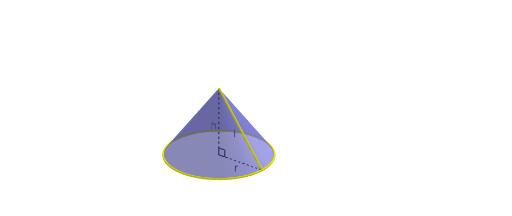
Loading the math board and drawing, please wait…
In collections
Area, Surface Area, Volume, Cross Section, 3D
3D Geometry & Cross Sections
Volumes and Surface Areas of Pyramids, Cones and Spheres
GCSE Higher Ch7 Area and Volume
Geometry: Surface Area & Volume
Geometry: Surface Area & Volume
Geometry: Surface Area & Volume
GA Chapter 11: Surface Area and Volume
Volumes and Surface Areas of Pyramids, Cones and Spheres
More about Volumes and Surface Areas
Connolly Geometry Volume
Volumes and Surface Areas of Pyramids, Cones and Spheres
Volumes and Surface Areas of Pyramids, Cones and Spheres
This example demonstrates how the curved surface of a cone can be flattened into a sector, dissected, and rearranged to show its area is πrl. It involves core concepts like surface area, cone geometry, Pythagorean theorem, and trigonometry. Constructed using commands like Point, If, Sequence, CircleArc, Segment, Midpoint, Circle, Intersect, Rotate, Surface, CircumcircleArc, Vector, and Angle. Ideal for high school mathematics education and geometric learning.
GeoGebra Commands & Parameters
Point(CircleArc[(0, 1), (1, 1), (0, 0)]) → QIf(y(Q) > 0, CircleArc[(0, 1), (0, 0), Q], 6.283185307179586) → sIf(y(Q) > 0, Angle[(0, 0), (0, 1), Q], 6.283185307179586) → α'Sequence((sin((i * θ)), 1 - cos((i * θ))), i, 0, (2 * n)) → list1If(t ≤ 1, t, 1) → kIf(t ≥ 1, t - 1, 0) → k'Sequence(If[k < 1, (x(O_1) + ((l * sin((i * φ))) * cos((i * φ)) / sin(φ)), y(O_1) + ((l * sin((i * φ))) * sin((i * φ)) / sin(φ))), (x(O_1) + (l * i), y(O_1))], i, 0, (2 * n)) → list2Sequence(Sector[Rotate[Translate[Circle[(x(O_1) + 0, y(O_1) + 1), Element[list1, i]], Vector[Element[list1, i], Element[list2, i]]], (((-((2 * i) - 1)) * k) * θ / 2), Element[list2, i]], Rotate[Translate[Element[list1, i], Vector[Element[list1, i], Element[list2, i]]], (((-((2 * i) - 1)) * k) * θ / 2), Element[list2, i]], Rotate[Translate[Element[list1, i + 1], Vector[Element[list1, i], Element[list2, i]]], (((-((2 * i) - 1)) * k) * θ / 2), Element[list2, i]]], i, 1, n) → list3CircleArc((0, 1 / (1 - m)), O_1, L) → bSegment((0, 0), (s, 0)) → dMidpoint(d) → B'CircleArc((0, 1), Q, (0, 0)) → cSegment(O, (x(O), y(O) - 1)) → eMidpoint(e) → GCircle((0, 1), 1) → gMidpoint(Q, O) → HSegment(O, A) → aCircle(P, 1, yAxis) → pIntersect(xOyPlane, p) → D, CRotate(O_1, α, a) → FSurface((u * cos(v)), (u * sin(v)) + 1, f(u), u, 0, abs(x(D)), v, -1.5708, (3 * π / 2) - (2 * γ)) → oRotate(D_1, α, a) → D'CircumcircleArc(D_1, C, D') → qCircle(O, D_1, a) → c_1Segment(P, D') → iSegment(P, D_1) → a_1Point(b) → JSegment(O, D_1) → b_1Vector(A + (0, 0, 0.3), A + (0, 0, 0.06)) → uAngle(D_1, O, A) → βSequence(Sector[Rotate[Rotate[Translate[Circle[(x(O_1) + 0, y(O_1) + 1), Element[list1, i]], Vector[Element[list1, i], Element[list2, i]]], (((-((2 * i) - 1)) * k) * θ / 2), Element[list2, i]], (180° * k'), (x(O_1) + (n * l) - sin(θ / 2) / 2, y(O_1) + cos(θ / 2) / 2)], Rotate[Rotate[Translate[Element[list1, i], Vector[Element[list1, i], Element[list2, i]]], (((-((2 * i) - 1)) * k) * θ / 2), Element[list2, i]], (180° * k'), (x(O_1) + (n * l) - sin(θ / 2) / 2, y(O_1) + cos(θ / 2) / 2)], Rotate[Rotate[Translate[Element[list1, i + 1], Vector[Element[list1, i], Element[list2, i]]], (((-((2 * i) - 1)) * k) * θ / 2), Element[list2, i]], (180° * k'), (x(O_1) + (n * l) - sin(θ / 2) / 2, y(O_1) + cos(θ / 2) / 2)]], i, n + 1, (2 * n)) → list4
AI Drawing Prompt Reference
Draw a cone's lateral surface area by first creating a circle centered at (0,1), then selecting a point Q on the circle and drawing an arc s. Next, construct an angle α'. Then, create a sequence of n points list1 and another sequence list2 based on k and k'. Using list1 and list2, rotate and translate to form a series of sectors, ultimately creating the unfolded lateral surface of the cone.
The prompt above was compiled from the original drawing commands and is for reference only.