
Cubic Function Through 4 Points
Loading the math board and drawing, please wait…
In collections
The GeoGebra's Toolbox for Teachers and Students
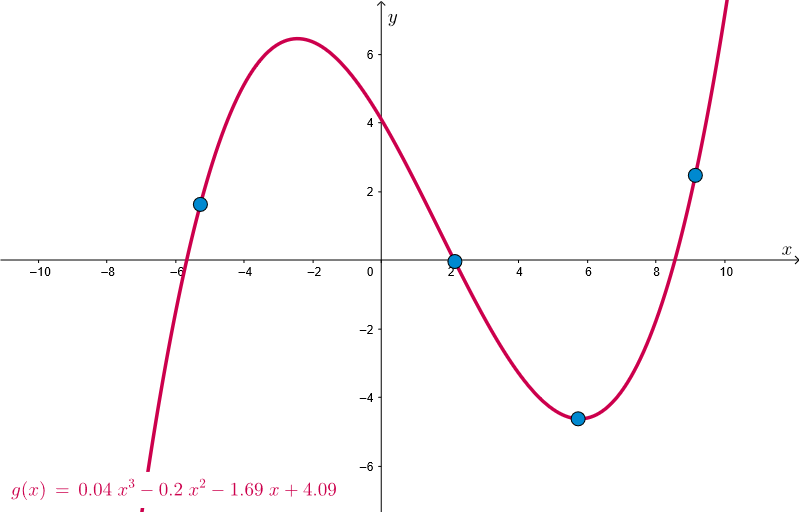
This example demonstrates how to determine a cubic function that passes through four given points. The core mathematical concepts include polynomial functions, interpolation, and solving systems of equations. Using GeoGebra's Polynomial command, the cubic function g is constructed based on the coordinates of four control points A, B, C, D, with the corresponding function expression displayed in LaTeX format. Learners can drag points A, B, C, D to change their positions and observe the dynamic changes in the cubic function graph. This example is suitable for high school mathematics courses, serving as an introduction to polynomial functions or as preparation for calculus studies.
GeoGebra Commands & Parameters
Polynomial({A, B, C, D}) → gLaTeX(g, true, true) → text1
AI Drawing Prompt Reference
Create a coordinate plane with four movable control points. Construct a cubic polynomial function g that passes through all four given points, ensuring the curve goes through each point. Display the corresponding function expression on the graph in formula form. Make the control points draggable so that, when their positions change, the cubic curve and the displayed expression update dynamically.
The prompt above was compiled from the original drawing commands and is for reference only.