
Cubes Illusion III
Loading the math board and drawing, please wait…
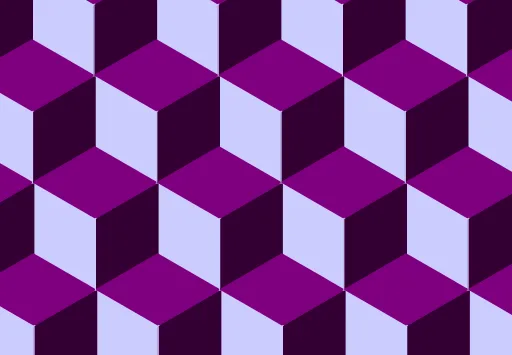
This example demonstrates the projection and illusion phenomena of 3D cubes onto 2D planes. Core math concepts include solid geometry, polygons, geometric transformations, parametric equations, and function graphing. Construction highlights involve GeoGebra commands like If, Sequence, Polygon, Rotate, utilizing objects such as n, t, taux1, PtsC1, taux, Pts, PtsC, C1, f, g, h, i, j, etc., for dynamic visualization. Suitable for high school and above students studying applications of solid geometry, geometric transformations, and parametric equations.
GeoGebra Commands & Parameters
If(0 ≤ t ≤ 1, 1.0E-5, If[1 < t ≤ 2, t - 1, 1]) → taux1Sequence(Rotate[((taux1 * cos(((i / n * 2) * π))), (taux1 * sin(((i / n * 2) * π)))), π / 6, (0, 0)], i, 1, n) → PtsC1If(0 ≤ t ≤ 1, t, 1) → tauxSequence(Rotate[(cos(((i / n * 2) * π)), sin(((i / n * 2) * π))), π / 6, (0, 0)], i, 1, n) → PtsSequence(Rotate[((taux * cos(((i / n * 2) * π))), (taux * sin(((i / n * 2) * π)))), π / 6, (0, 0)], i, 1, n) → PtsCPolygon(Element[Pts, 2], Element[Pts, 3], Element[Pts, 4], (0, 0), Element[Pts, 2]) → C1, f, g, h, i, jRotate(C1, (2 * π / 3), (0, 0)) → L1Rotate(C1, ((2 * 2) * π / 3), (0, 0)) → L2Rotate(C1, ((3 * 2) * π / 3), (0, 0)) → L3Polygon(Element[PtsC, 3], Element[PtsC, 4], Element[PtsC, 5], (0, 0), Element[PtsC, 3]) → C2, k, l, m, p, qRotate(C2, (2 * π / 3), (0, 0)) → M1Rotate(C2, ((2 * 2) * π / 3), (0, 0)) → M2Polygon(Element[PtsC1, 2], Element[PtsC1, 3], Element[PtsC1, 4], (0, 0), Element[PtsC1, 2]) → C3, r, s, a, b, cRotate(C2, ((3 * 2) * π / 3), (0, 0)) → M3Rotate(C3, (2 * π / 3), (0, 0)) → N1Rotate(C3, ((2 * 2) * π / 3), (0, 0)) → N2Rotate(C3, ((3 * 2) * π / 3), (0, 0)) → N3Sequence(Sequence[Translate[Translate[L1, Vector[(i * Vector[(0, 0), (0.43, 0.75)])]], Vector[(0, 0), (((j * 2) * 0.87), 0)]], i, 2, width, 2], j, 0, height) → L_1Sequence(Sequence[Translate[Translate[L2, Vector[(i * Vector[(0, 0), (0.43, 0.75)])]], Vector[(0, 0), (((j * 2) * 0.87), 0)]], i, 2, width, 2], j, 0, height) → L_2Sequence(Sequence[Translate[Translate[L3, Vector[(i * Vector[(0, 0), (0.43, 0.75)])]], Vector[(0, 0), (((j * 2) * 0.87), 0)]], i, 2, width, 2], j, 0, height) → L_3Sequence(Sequence[Translate[Translate[M1, Vector[(i * Vector[(0, 0), (0.43, 0.75)])]], Vector[(0, 0), (((j * 2) * 0.87), 0)]], i, 2, width, 2], j, 0, height) → M_1Sequence(Sequence[Translate[Translate[M2, Vector[(i * Vector[(0, 0), (0.43, 0.75)])]], Vector[(0, 0), (((j * 2) * 0.87), 0)]], i, 2, width, 2], j, 0, height) → M_2Sequence(Sequence[Translate[Translate[M3, Vector[(i * Vector[(0, 0), (0.43, 0.75)])]], Vector[(0, 0), (((j * 2) * 0.87), 0)]], i, 2, width, 2], j, 0, height) → M_3Sequence(Sequence[Translate[Translate[N1, Vector[(i * Vector[(0, 0), (0.43, 0.75)])]], Vector[(0, 0), (((j * 2) * 0.87), 0)]], i, 2, width, 2], j, 0, height) → N_1Sequence(Sequence[Translate[Translate[N2, Vector[(i * Vector[(0, 0), (0.43, 0.75)])]], Vector[(0, 0), (((j * 2) * 0.87), 0)]], i, 2, width, 2], j, 0, height) → N_2Sequence(Sequence[Translate[Translate[N3, Vector[(i * Vector[(0, 0), (0.43, 0.75)])]], Vector[(0, 0), (((j * 2) * 0.87), 0)]], i, 2, width, 2], j, 0, height) → N_3
AI Drawing Prompt Reference
Draw a 3D projection of a cube, including three rotated cube faces, each made up of four vertices. Use rotations and translations to generate multiple repeated cube faces, creating a 3D illusion of a cube.
The prompt above was compiled from the original drawing commands and is for reference only.