
Cube Dissection Problem
Loading the math board and drawing, please wait…
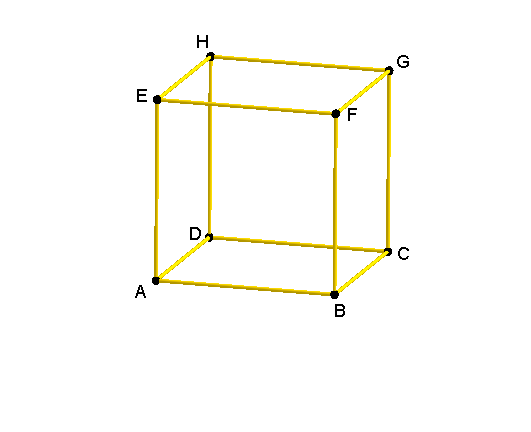
This example demonstrates the process and properties of dissecting a cube into different parts using planes. Core mathematical concepts include solid geometry, planes, integers, matrices, combinatorics, and congruence. It utilizes GeoGebra commands and objects like Point, Cube, Segment, Polygon, Midpoint, Intersect, Pyramid, If, and Sequence as outlined in the construction summary. Suitable for high school students and math enthusiasts learning about solid geometry dissection, matrix applications, and combinatorial counting.
GeoGebra Commands & Parameters
Point(Circle[B, Distance[A, B], Segment[A, B]]) → CCube(A, B, C) → a, D, faceCDHG, faceEFGH, edgeAD, edgeAB, edgeBC, edgeCD, edgeAE, edgeDH, edgeEH, edgeEF_1, E, edgeBF, edgeFG, edgeCG, edgeGH, F, G, H, faceABCD, faceADHE, faceABFE, faceBCGFSegment(A, F) → bSegment(B, E) → cSegment(B, G) → dSegment(C, F) → eSegment(C, H) → fSegment(D, G) → gSegment(A, H) → hSegment(D, E) → iSegment(E, G) → jSegment(F, H) → kSegment(A, C) → lSegment(B, D) → mPolygon(A, C, F) → poly1, f_1, a_1, c_1Polygon(D, G, E) → poly2, e_1, d_1, g_1Polygon(A, F, H) → poly3, h_1, a_2, f_2Polygon(B, D, G) → poly4, g_2, b_1, d_2Polygon(D, B, E) → poly5, e_2, d_3, b_2Polygon(A, C, H) → poly6, h_2, a_3, c_2Polygon(A, B, G, H) → poly7, a_4, b_3, g_3, h_3Polygon(B, C, H, E) → poly8, b_4, c_3, h_4, e_3Polygon(C, D, E, F) → poly9, c_4, d_4, e_4, f_3Polygon(D, A, F, G) → poly10, d_5, a_5, f_4, g_4Polygon(B, D, H, F) → poly11, b_5, d_6, h_5, f_5Polygon(C, A, E, G) → poly12, c_5, a_6, e_5, g_5Polygon(B, G, E) → poly13, e_6, b_6, g_6Polygon(C, F, H) → poly14, h_6, c_6, f_6Midpoint(A, F) → IMidpoint(B, G) → JMidpoint(C, H) → KMidpoint(E, D) → LMidpoint(F, H) → MMidpoint(B, D) → NIntersect(IntersectPath[Plane[B, E, G], Plane[A, F, H]], Plane[C, D, E]) → OIntersect(IntersectPath[Plane[B, E, G], Plane[A, F, D]], Plane[F, D, E]) → PIntersect(IntersectPath[Plane[B, E, H], Plane[A, F, D]], Plane[F, D, E]) → QIntersect(IntersectPath[Plane[A, F, H], Plane[B, E, H]], Plane[F, D, E]) → RPyramid(P, O, R, Q, I) → o_1, faceOPQR, edgeIP_1, edgeIO_1, edgeIR_1, edgeIQ, faceIOP_1, faceIOR_1, faceIQR, faceIPQ, edgeOP_1, edgeOR_1, edgeQR, edgePQPyramid(P, O, I, F) → p_1, faceIOP, edgeFI_1, faceFOP, faceFIO_1, faceFIP, edgeOP, edgeIO_2, edgeIP, edgeFP, edgeFO_1Pyramid(O, R, I, E) → q_1, faceIOR, edgeEI_1, faceEOR, faceEIR, faceEIO_1, edgeOR, edgeIR, edgeIO_3, edgeEO_1, edgeERPyramid(E, I, F, O) → r_1, faceEFI, edgeFO, faceEIO, faceFIO, faceEFO, edgeEI, edgeFI, edgeEF, edgeEO, edgeIOIf(t < 1, t, 1) → t1If((t ≥ 1) ∧ (t < 2), t - 1, If[t < 1, 0, 1]) → t2If((t ≥ 2) ∧ (t < 3), t - 2, If[t < 2, 0, 1]) → t3Sequence(Rotate[Translate[r_1, Vector[(t1 * u_1) + (t1 * v_1)]], (90° * i), Segment[I, K]], i, 0, 3) → list4Sequence(Rotate[Translate[p_1, Vector[(t2 * u_1) + (t2 * v_1)]], (90° * i), Segment[I, K]], i, 0, 3) → list2Sequence(Rotate[Translate[q_1, Vector[(t2 * u_1) + (t2 * v_1)]], (90° * i), Segment[I, K]], i, 0, 3) → list3Sequence(Rotate[Translate[o_1, Vector[(t3 * u_1) + (t3 * v_1)]], (90° * i), Segment[I, K]], i, 0, 3) → list1