
Cube Bisecting Example
Loading the math board and drawing, please wait…
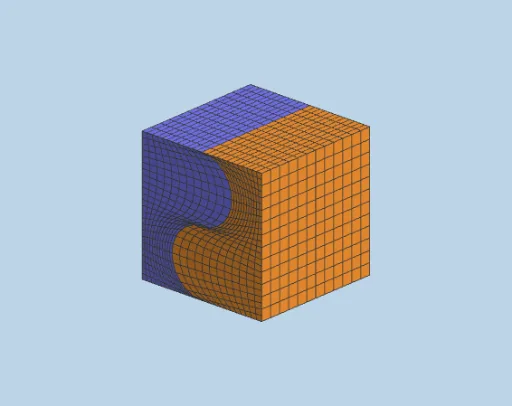
This example demonstrates the bisection of a cube. It involves core math concepts like solid geometry, parametric equations, and vector operations. Construction highlights include using GeoGebra commands such as Cube, Midpoint, Segment, Line, Vector, CurveCartesian, Mirror, Translate, and Surface. Suitable for high school students and math enthusiasts exploring spatial geometry and parametric equations.
GeoGebra Commands & Parameters
Cube(A, B, C) → cubo, D, caraCDHG, caraEFGH, aristaAD, aristaAB, aristaBC, aristaCD, aristaAE, aristaDH, aristaEH, aristaEF, E, aristaBF, aristaFG, aristaCG, aristaGH, F, G, H, caraABCD, caraADHE, caraABFE, caraBCGFMidpoint(F, A) → IMidpoint(H, C) → JMidpoint(E, F) → KMidpoint(H, G) → LSegment(I, J) → fLine(K, L) → iVector(D, A) → uMidpoint(C, D) → MMidpoint(E, C) → NMidpoint(J, L) → OMidpoint(aristaDH) → PMidpoint(P, H) → QCurveCartesian((a / 2 * sin((π * t))), a, (a / 2 * cos((π * t))) + a / 2, t, 0, 1) → bMirror(b, J) → cTranslate(b, u) → b'Translate(c, u) → c'Surface((b(t) * k) + (b'(t) * (1 - k)), k, 0, 1, t, 0, 1) → d_1Surface((c(t) * k) + (c'(t) * (1 - k)), k, 0, 1, t, 0, 1) → eMidpoint(aristaCG) → RCurveCartesian((R * k) + (G * (1 - k)), k, 0, 1) → s1Surface((s1(t) * k) + (b(t) * (1 - k)), k, 0, 1, t, 0, 1) → dCurveCartesian((R * k) + (C * (1 - k)), k, 0, 1) → s2Surface((s2(t) * k) + (c(t) * (1 - k)), k, 0, 1, t, 0, 1) → gTranslate(g, u) → g'Translate(d, u) → d'CurveCartesian((G * k) + (F * (1 - k)), k, 0, 1) → s3CurveCartesian((L * k) + (K * (1 - k)), k, 0, 1) → s4Surface((s3(t) * k) + (s4(t) * (1 - k)), k, 0, 1, t, 0, 1) → hVector(G, C) → vCurveCartesian((C * k) + (B * (1 - k)), k, 0, 1) → s5Surface((s3(t) * k) + (s5(t) * (1 - k)), k, 0, 1, t, 0, 1) → jTranslate(h, v) → h'Vector(M, C) → wTranslate(l1, Vector[(m * w)]) → l2Mirror(l2, N) → l3
AI Drawing Prompt Reference
Draw a cube and show its bisection by two symmetric curved surfaces. Start with the cube's eight vertices and connect them to form six faces. Inside the cube, select midpoints of several edges and connect them to create two crossing line segments as reference guides. From a midpoint on one edge, draw a semicircular arc, then mirror it about another midpoint to get a second arc. Translate both arcs along one direction of the cube to form two curved surfaces. Then, by connecting edge midpoints to vertices, construct two slanted planes that combine with the curved surfaces, resulting in a complete cutting surface that divides the cube into two parts. The overall view shows the spatial geometric division in three dimensions.
The prompt above was compiled from the original drawing commands and is for reference only.