
Cruciform Curve as a Parametric Curve in 3D Space
Loading the math board and drawing, please wait…
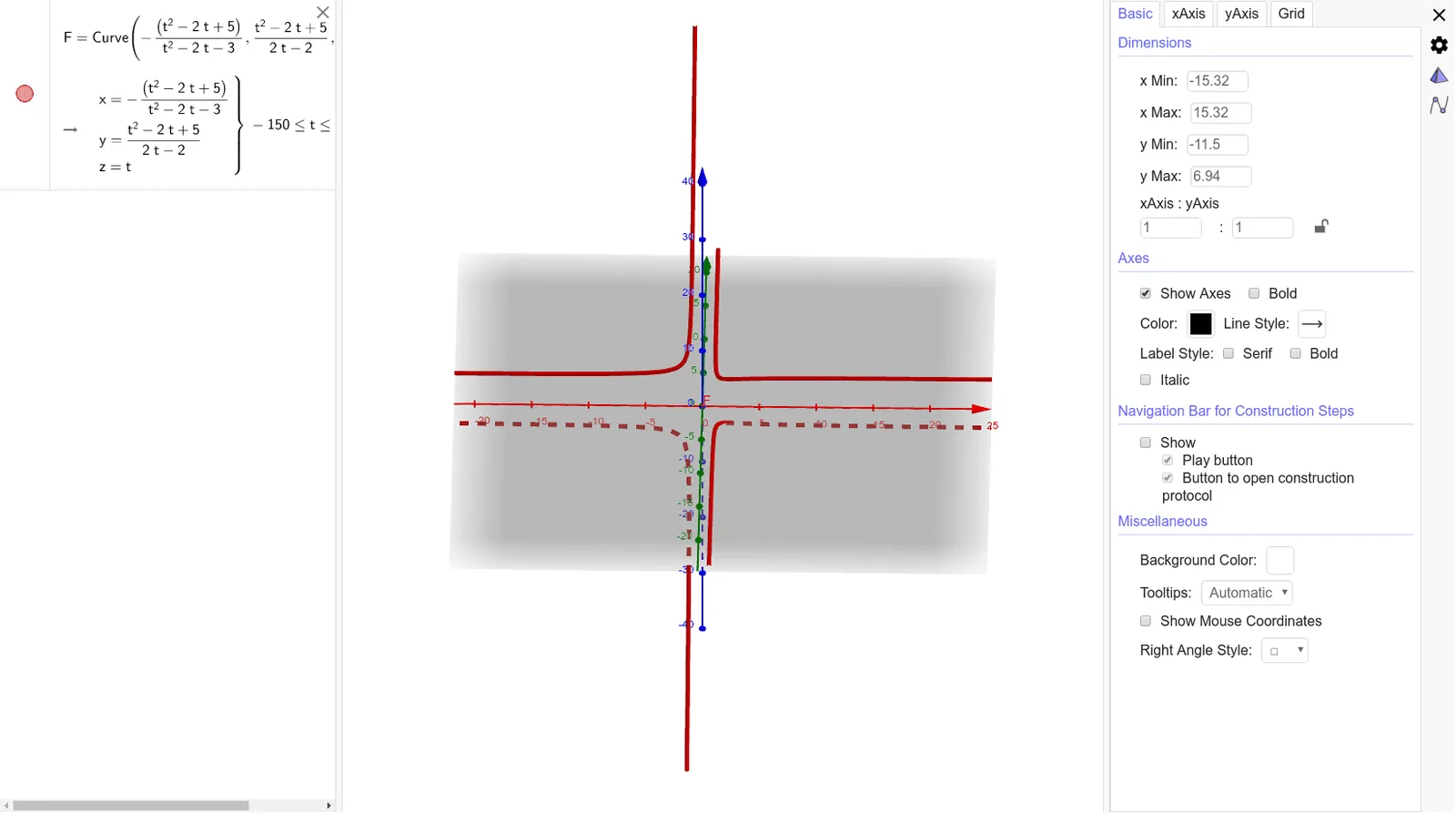
This example demonstrates the cruciform curve, a parametric curve defined in three-dimensional space, using GeoGebra's CurveCartesian command. The curve exhibits a cross-shaped cross-section, illustrating how algebraic expressions involving roots, fractions, and geometric means can generate intricate spatial forms. The construction relies on the CurveCartesian command, where the x, y, and z coordinates are expressed as functions of a parameter t, incorporating radical and fractional operations. This example is suitable for high school to university students studying parametric equations, three-dimensional coordinate geometry, or mathematical modeling. It serves as an excellent teaching tool for visualizing how parametric definitions translate abstract algebraic formulas into concrete geometric shapes, deepening understanding of spatial curves and the role of parameters in defining complex trajectories.
GeoGebra Commands & Parameters
CurveCartesian(((-(t^(2) - (2 * t) + 5))) / (t^(2) - (2 * t) - 3), (t^(2) - (2 * t) + 5) / ((2 * t) - 2), t, t, -150, 150) → F
AI Drawing Prompt Reference
Draw a cruciform curve in 3D space using the parameter t for x, y, and z coordinates. The x-coordinate is -(t^2 - 2t + 5) / (t^2 - 2t - 3), the y-coordinate is (t^2 - 2t + 5) / (2t - 2), and the z-coordinate is the same. The parameter t ranges from -150 to 150.
The prompt above was compiled from the original drawing commands and is for reference only.