
Intersection of Cylinder and Paraboloid
Loading the math board and drawing, please wait…
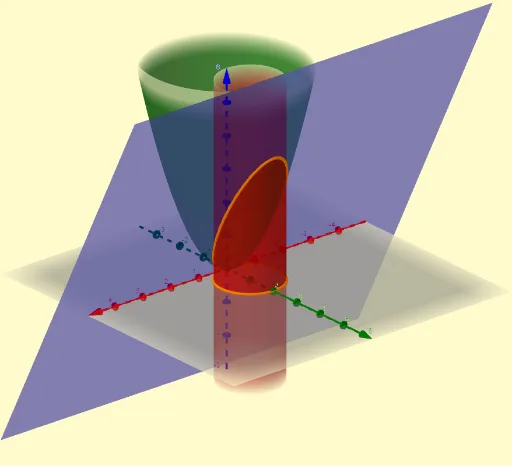
This example visualizes the spatial curve formed by the intersection of an infinite cylinder and a paraboloid in 3D space. The core mathematical concepts involve quadratic surfaces (cylinder and paraboloid), solving their intersection, and parametric representation of space curves. Construction highlights: using GeoGebra's InfiniteCylinder command to create the infinite cylinder, and IntersectPath to compute the intersection path between the two surfaces, generating objects c, a, b, d, e, f. Suitable for high school or early college students to understand the geometric shape of surface intersections in solid analytic geometry, and as a visual aid in math lab sessions exploring properties of quadric surfaces. Rotating the view reveals how the intersection curve changes under different projections, enhancing spatial reasoning skills.
GeoGebra Commands & Parameters
InfiniteCylinder((0, 1, 0), (0, 1, 1), 1) → aIntersectPath(d, a) → eIntersectPath(xOyPlane, a) → f
AI Drawing Prompt Reference
Draw an infinite cylinder with its base center at point (0,1,0) and height parallel to the z-axis with radius 1. Then, plot the spatial curve formed by the intersection of this cylinder and a paraboloid with its vertex at the origin and opening upwards. Finally, show the projection of this intersection curve onto the xOy plane.
The prompt above was compiled from the original drawing commands and is for reference only.