
Critical Damping ODE Graphing
Loading the math board and drawing, please wait…
In collections
MATH1052-edX
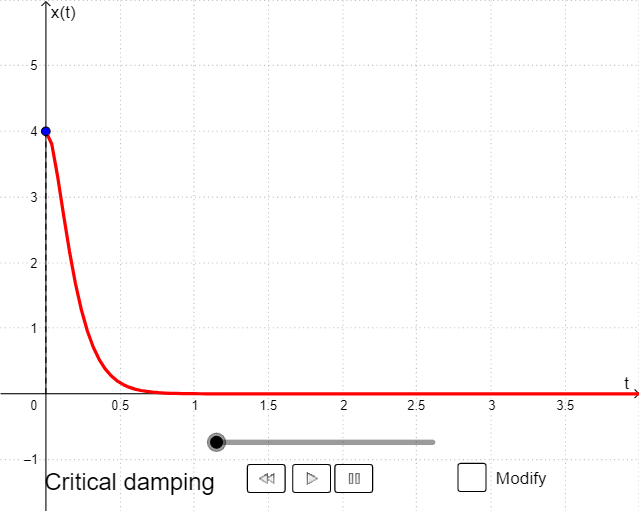
This example demonstrates the motion of a spring-mass system under critical damping. Key mathematical concepts include differential equations, damping coefficients, and system response. Construction involves using SolveODE to solve the ODE, Length to compute displacement, First to extract initial conditions, If and Zip for parameter mapping, Max and Min to determine motion ranges, and Segment to draw the trajectory. Suitable for high school physics or university calculus courses to understand dynamic behavior of damped systems.
GeoGebra Commands & Parameters
SolveODE((2 * p), ω^(2), 0, 0, x0, xprime0, maxTime, 0.04) → SolutionLength(Solution) → lenFirst(Solution, len) → LPIf(D < 0, "Underdamping", If[D ≟ 0, "Critical damping", "Overdamping"]) → textClassZip(y(P), P, LP) → LxPMax(LxP) → maxMin(LxP) → minSegment(C1, C2) → platformTextfield(x0) → Inpx0Textfield(xprime0) → Inpxprime0Textfield(m) → InpmTextfield(k) → InpkTextfield(β) → InpβRay((100, 0), (-100, 0)) → eqposIf(ylength < 0, CurveCartesian[(width * sin((((fr * 2) * π) * (t - y_1) / (y_0 - y_1)))) + x(A2), t, t, y_0, y_1], CurveCartesian[(width * sin((((fr * 2) * π) * (t - y_1) / (y_0 - y_1)))) + x(A2), t, t, y_1, y_0]) → springCurveCartesian((width * sin((((fr * 2) * π) * (t - sect) / (y_0 - sect)))) + x(A2), t, t, sect, y_0) → springFixedSegment(PS, PS + (0, sect)) → endSegment((x(A2), 0), (x(A2), 0) + (0, sect)) → endFixedIf(abs(max) < 0.4, 0.5, max) → ymaxIf(abs(min) < 0.4, -1.2, min) → yminSegment((0, ftime), ((facTime * time), ftime)) → horSegment(((facTime * time), 0), ((facTime * time), ftime)) → verTextfield(maxTime) → InpMTime
AI Drawing Prompt Reference
Draw a graph showing the motion of a spring-mass system under critical damping. Start by plotting a horizontal line for the equilibrium position. Then, solve a differential equation with given initial displacement and velocity to obtain the trajectory of the mass, connecting key points with line segments. Indicate whether the system is underdamped, critically damped, or overdamped based on the damping coefficient and label the state. Finally, draw a sinusoidal wave below the trajectory representing the spring's vibration, with its amplitude decreasing over time.
The prompt above was compiled from the original drawing commands and is for reference only.