
Create Prism with Unity Cubes to Understand Volume
Loading the math board and drawing, please wait…
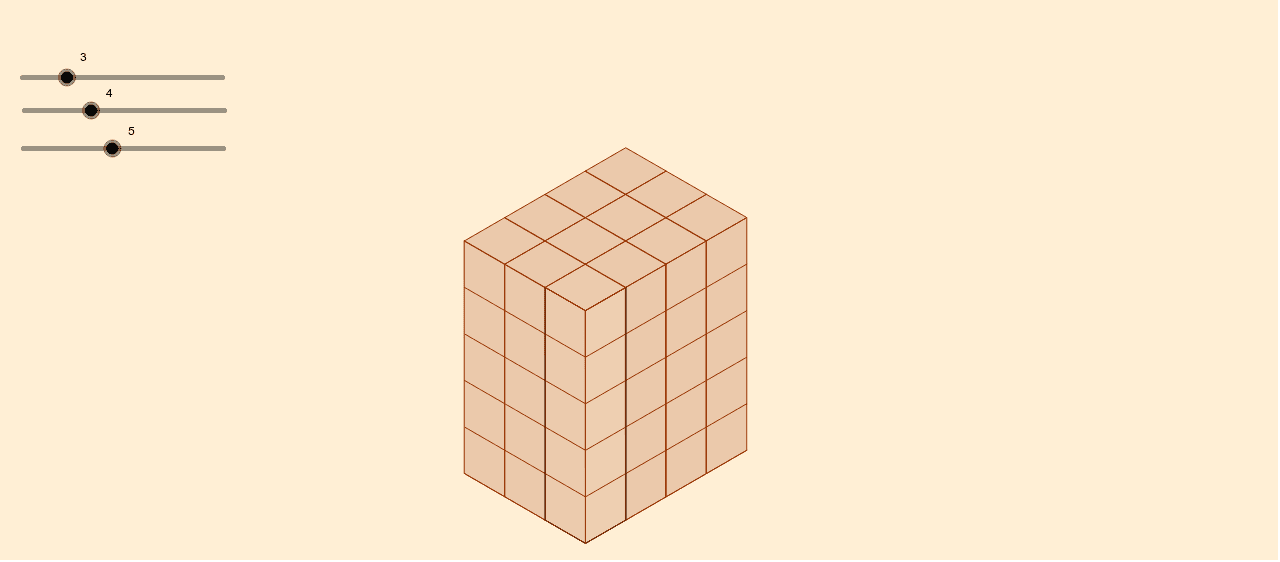
① This GeoGebra material demonstrates how a prism can be built from unit cubes, making the concept of volume tangible and visual. ② Core mathematical concepts include volume of prisms, unit cubes, spatial composition, and the relationship between base area and height. ③ Construction highlights: using commands such as Intersect, Vector, Segment, Line, Point, Polygon, Translate, and Sequence, the base polygon is first defined, then translated repeatedly to stack layers of cubes, forming a complete prism; key objects include points, vectors, segments, polygons, and auxiliary elements. ④ Suitable for middle or high school students learning solid geometry and volume, ideal for interactive exploration and classroom demonstrations to strengthen spatial reasoning.
GeoGebra Commands & Parameters
Intersect(xAxis, yAxis) → HVector(H, I) → uSegment(D, C) → bSegment(C, F) → fSegment(D, G) → gSegment(G, F) → hSegment(F, E) → iLine(E, F) → jLine(H, j) → k_1Segment(E, B) → aSegment(B, C) → cPoint(yAxis) → AVector(H, A) → vVector(H, J) → wPolygon(B, C, F, E) → çokgen1, b_1, c_1, f_1, e_1Polygon(C, D, G, F) → çokgen2, c_2, d_1, g_1, f_2Polygon(B, K, D, C) → çokgen3, b_2, k_2, d, c_3Translate(B, u) → B'Translate(K, u) → K'Translate(D, u) → D'Translate(C, u) → C'Intersect(j, f) → LIntersect(g, h) → MLine(L, M) → qTranslate(B, w) → B'_1Translate(K, w) → K'_1Translate(D, w) → D'_1Translate(C, w) → C'_1Translate(B', w) → B''Translate(K', w) → K''Translate(D', w) → D''Translate(C', w) → C''Translate(B'', w) → B'''Translate(K'', w) → K'''Translate(D'', w) → D'''Translate(C'', w) → C'''Translate(B''', w) → NTranslate(K''', w) → OTranslate(D''', w) → PTranslate(C''', w) → QTranslate(N, w) → N'Translate(O, w) → O'Translate(P, w) → P'Translate(Q, w) → Q'Translate(B'', w) → B'''_1Translate(K'', w) → K'''_1Translate(D'', w) → D'''_1Translate(C'', w) → C'''_1Translate(B'''_1, w) → RTranslate(K'''_1, w) → STranslate(D'''_1, w) → TTranslate(C'''_1, w) → UTranslate(R, w) → R'Translate(S, w) → S'Translate(T, w) → T'Translate(U, w) → U'Intersect(j, q) → VIntersect(b, f) → WIntersect(b_2, k_2) → Z_1Intersect(b_2, k_2) → K_1Translate(C, w) → C'_2Translate(D, w) → D'_2Translate(G, w) → G'Translate(F, w) → F'Sequence(Polygon[Translate[B, Vector[(i * u)]], Translate[K, Vector[(i * u)]], Translate[D, Vector[(i * u)]], Translate[C, Vector[(i * u)]]], i, 1, k - 1) → liste3Sequence(Translate[Element[liste1, 1], Vector[(i * u)]], i, 1, k - 1) → liste4Sequence(Polygon[Translate[B, Vector[(i * u)]], Translate[C, Vector[(i * u)]], Translate[F, Vector[(i * u)]], Translate[E, Vector[(i * u)]]], i, 1, k - 1) → liste5Sequence(Segment[Translate[F, Vector[(u * i)]], Translate[E, Vector[(u * i)]]], i, 0, k - 1) → liste10Sequence(Translate[liste10, Vector[(v * i)]], i, 1, o - 1) → liste11Sequence(Segment[Translate[G, Vector[(w * i)]], Translate[F, Vector[(w * i)]]], i, 0, m - 1) → liste12Sequence(Translate[liste12, Vector[(v * i)]], i, 1, o - 1) → liste13
AI Drawing Prompt Reference
Draw a prism composed of unit cubes to illustrate the concept of volume. Start by defining a polygon as the base, then repeatedly translate the base along a vector perpendicular to it to stack layers of cubes, forming a complete prism. Key elements include points, vectors, segments, and polygons, constructed through translation and intersection to show the faces and stacking of the prism, ideal for understanding volume and spatial geometry.
The prompt above was compiled from the original drawing commands and is for reference only.