
Create a Linear System to Solve an Application Problem
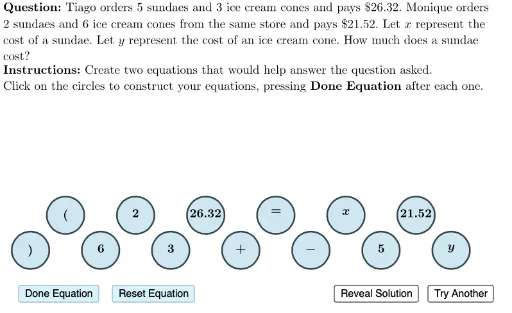
Loading the math board and drawing, please wait…
This example demonstrates how to create a linear system to solve an application problem. Key mathematical concepts include linear equations. Main GeoGebra commands used include Element, Length, Join, Zip, Sequence, etc. Suitable for middle school and above students or teachers.
GeoGebra Commands & Parameters
Element(questionList, questionListIndex) → questionNumElement(A2:A4, questionNum) → questionTextLaTeX((((("\text{" * QUESTION) * "\\") * INSTRUCTIONS) * "}")) → TEXTLength(B2) → C2Join({Sequence[(i, firstPointY), i, firstPointX, firstPointX + 36, 6], Sequence[(i, firstPointY + 3), i, firstPointX + 3, firstPointX + 36, 6]}) → pointListZip(Circle[A, 1.6], A, pointList) → circleListElement(B2:B4, questionNum) → itemListValsElement(circleList, 1) → circle1Element(circleList, 2) → circle2Element(circleList, 3) → circle3Element(circleList, 4) → circle4Element(circleList, 5) → circle5Element(circleList, 6) → circle6Element(circleList, 7) → circle7Element(circleList, 8) → circle8Element(circleList, 9) → circle9Element(circleList, 10) → circle10Element(circleList, 11) → circle11Length(B3) → C3Length(B4) → C4Element(D2:D4, questionNum) → correctEquation1Element(E2:E4, questionNum) → correctEquation2Element(circleList, 12) → circle12Element(circleList, 13) → circle13Sequence(Text[TableText[{{Element[itemListVals, Element[itemListOrder, i]], "\hphantom{00.00}"}}, "vc"], Element[pointList, i] + (-2.1, 0.9), false, true], i, 1, 13) → circleContents