
Corresponding Angles Theorem Demo
Loading the math board and drawing, please wait…
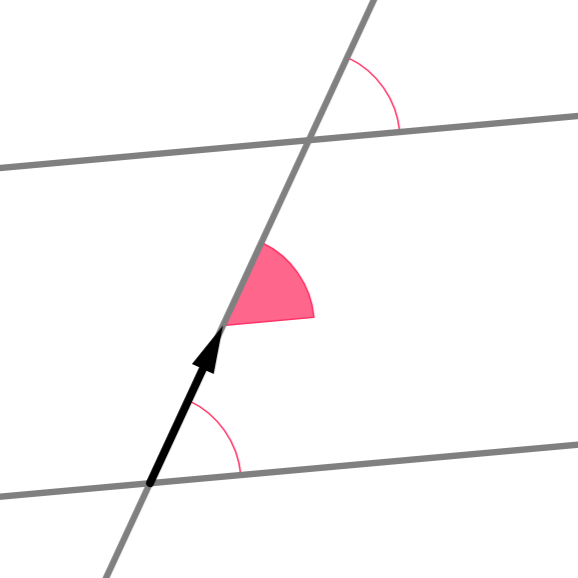
This example demonstrates the concept of corresponding angles formed by parallel lines and a transversal, illustrating that they are equal. It involves core math concepts like corresponding angles, properties of parallel lines, and angle measurement. The construction utilizes GeoGebra commands/objects such as Point, Rotate, Angle, Line, Circle, Intersect, CircleSector, Dilate, Vector, Translate, and CircleArc. It is suitable for high school mathematics education to visually explain the Corresponding Angles Theorem and its applications.
GeoGebra Commands & Parameters
Point(a) → BRotate(B, α, A) → B'Angle(B, A, B') → βLine(A, B') → bCircle(A, 1) → eIntersect(b, d) → CCircle(C, 1) → fIntersect(e, a) → D, EIntersect(e, b) → F, GIntersect(f, b) → H, IIntersect(f, d) → J, KCircleSector(C, K, I) → gCircleSector(C, I, J) → hCircleSector(C, J, H) → kCircleSector(C, H, K) → pCircleSector(A, E, G) → qCircleSector(A, G, D) → rCircleSector(A, D, F) → sCircleSector(A, F, E) → tDilate(A, If[0 < i < 1, 1 - i], C) → A'Vector(A, A') → uTranslate(q, u) → q'Translate(r, u) → r'Translate(s, u) → s'Translate(t, u) → t'CircleArc(A, E, G) → c_1CircleArc(C, K, I) → d_1CircleArc(C, I, J) → e_1CircleArc(A, G, D) → f_1CircleArc(A, D, F) → g_1CircleArc(C, J, H) → h_1CircleArc(A, F, E) → k_1CircleArc(C, H, K) → p_1