
Copy of Volumes: Exploring Volume through Geometric Transformations
Loading the math board and drawing, please wait…
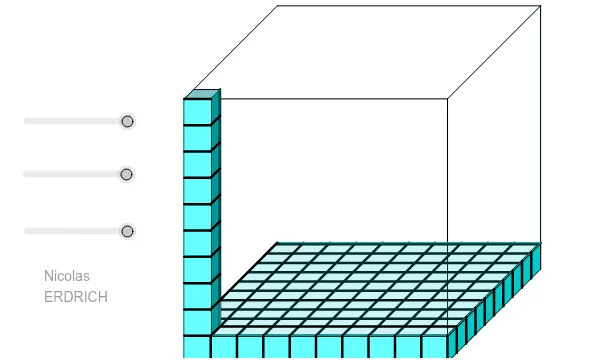
① This GeoGebra example dynamically demonstrates the projection and replication of 3D volume concepts onto a 2D plane, using rotations, translations, and sequences to construct multiple polygons and compute their areas, thereby visually illustrating the relationship between volume and area. ② Core mathematical concepts include volume, angles, linear equations, triangles, basic calculus, and geometric transformations, involving polygon area calculation, rotational symmetry, and sequence generation. ③ Construction highlights: Commands such as Line, OrthogonalLine, Circle, Intersect, Rotate, Angle, Segment, Midpoint, Polygon, Translate, Sequence, and Point are used to create multiple points, lines, circles, and polygon objects (e.g., A, B, E, F, S', poly1, poly2, poly3), with rotations and translations producing differently positioned figures, and angle and segment measurements aiding analysis. ④ Suitable for upper secondary to early university students, this serves as a bridge between geometry and calculus, and as an interactive tool for teachers to demonstrate volume concepts and geometric transformations.
GeoGebra Commands & Parameters
Line(A, xAxis) → aOrthogonalLine(A, a) → q_4Circle(A, 2) → rIntersect(r, q_4, 2) → EIntersect(r, a, 2) → BOrthogonalLine(E, q_4) → sOrthogonalLine(B, a) → tIntersect(s, t) → FRotate(F, 45*°, E) → S'Angle(F, E, S') → αSegment(E, S') → i_1Segment(E, F) → j_1Midpoint(j_1) → TCircle(E, T) → k_1Intersect(k_1, i_1, 1) → HSegment(E, H) → p_1Line(H, j_1) → q_1Line(F, p_1) → r_1Intersect(q_1, r_1) → VSegment(A, E) → s_1Segment(F, B) → t_1Line(B, r_1) → a_2Line(V, s_1) → b_2Intersect(a_2, b_2) → WPolygon(A, B, F, E) → poly1, p_2, r_2, s_2, q_2Polygon(B, W, V, F) → poly2, r_3, w, v, s_3Polygon(E, F, V, H) → poly3, q_3, s_4, v_1, uTranslate(A, B - A) → A'Translate(E, B - A) → E'Sequence(Sequence[Polygon[Translate[A, Vector[k * Vector[A, B] + l * Vector[A, E]]], Translate[B, Vector[k * Vector[A, B] + l * Vector[A, E]]], Translate[F, Vector[k * Vector[A, B] + l * Vector[A, E]]], Translate[E, Vector[k * Vector[A, B] + l * Vector[E, A]]]], k, 0, o], l, 0, 0) → ligneSequence(Sequence[Polygon[Translate[E, Vector[l * Vector[A, B] + m * Vector[E, H]]], Translate[F, Vector[l * Vector[A, B] + m * Vector[E, H]]], Translate[V, Vector[l * Vector[A, B] + m * Vector[E, H]]], Translate[H, Vector[l * Vector[A, B] + m * Vector[E, H]]]], l, 0, o], m, 0, q) → liste3Sequence(Polygon[Translate[B, k * (W - B) + o * (B - A)], Translate[W, k * (W - B) + o * (B - A)], Translate[V, k * (W - B) + o * (B - A)], Translate[F, k * (W - B) + o * (B - A)]], k, 0, q) → ligne2Sequence(Sequence[Polygon[Translate[A, Vector[k * Vector[B, A] - l * Vector[E, A]]], Translate[B, Vector[k * Vector[B, A] - l * Vector[E, A]]], Translate[F, Vector[k * Vector[B, A] - l * Vector[E, A]]], Translate[E, Vector[k * Vector[B, A] - l * Vector[E, A]]]], k, 0, 0], l, 0, p) → listeSequence(Sequence[Polygon[Translate[B, Vector[-l * Vector[E, A] + m * Vector[E, H]]], Translate[W, Vector[-l * Vector[E, A] + m * Vector[E, H]]], Translate[V, Vector[-l * Vector[E, A] + m * Vector[E, H]]], Translate[F, Vector[-l * Vector[E, A] + m * Vector[E, H]]]], l, 0, p], m, 0, 0) → liste2Translate(E, p * (E - A)) → E'_1Translate(F, p * (E - A)) → F'Translate(V, p * (E - A)) → V'Translate(H, p * (E - A)) → H'Polygon(E'_1, F', V', H') → Haut, e'_1, f', v', h'Translate(A, (o + 1) * (B - A)) → Sommet1Translate(A, (p + 1) * (E - A)) → Sommet2OrthogonalLine(E'_1, s_1) → bOrthogonalLine(Sommet1, p_2) → cIntersect(b, c) → Sommet3Translate(A, (q + 1) * (H - E)) → Sommet4OrthogonalLine(Sommet4, p_2) → dSegment(A, Sommet4) → eSegment(A, E'_1) → fLine(E'_1, e) → gIntersect(d, g) → CLine(Sommet3, g) → hLine(C, b) → iIntersect(h, i) → DLine(D, d) → jLine(Sommet1, h) → kIntersect(j, k) → GSegment(E'_1, Sommet3) → lSegment(Sommet3, Sommet1) → mSegment(Sommet3, D) → nSegment(D, G) → a_1Segment(D, C) → b_1Segment(C, E'_1) → c_1Segment(F', B) → d_1Segment(V', V) → e_1Segment(H', V') → f_1Segment(A, Sommet1) → g_1Point(g_1) → ISegment(I, G) → h_1Segment(F, E) → l_1Segment(F, B) → m_1Line(E, g_1) → n_1Intersect(n_1, m) → JSegment(F, J) → c_2Segment(F', V') → d_2Segment(B, W) → e_2Line(J, h_1) → f_2Intersect(a_1, f_2) → KPoint(h_1) → LSegment(L, K) → g_2Segment(J, K) → h_2Line(H, h_1) → i_2Line(K, l) → j_2Intersect(i_2, j_2) → MSegment(M, K) → k_2Intersect(i_2, e_1) → NSegment(N, M) → l_2Intersect(r_1, j_2) → OSegment(F, O) → m_2Sequence(Segment[Translate[F, -k * (A - B)], Translate[O, -k * (A - B)]], k, 0, o) → seg4Line(N, b_1) → n_2Intersect(n_2, h_2) → PSegment(N, P) → t_2Line(V, t_2) → a_3Intersect(a_3, h_2) → QLine(S', a_3) → b_3Intersect(b_3, h_2) → RSegment(V, Q) → c_3Polygon(F, V, N, M, K, J) → poly4, f_3, v_2, n_3, m_3, k_3, j_3Polygon(V, F, F', V') → poly5, v_3, f_4, f'_1, v'_1Segment(N, M) → d_3Segment(M, K) → e_3Sequence(Segment[Translate[F, -k * (A - E)], Translate[E, -k * (A - E)]], k, 0, p) → seg_1Sequence(Segment[Translate[F, k * (B - A)], Translate[B, k * (B - A)]], k, 0, o) → seg_2Sequence(Segment[Translate[F, -l * (E - H) + o * (B - A)], Translate[B, -l * (E - H) + o * (B - A)]], l, 1, q) → seg10Sequence(Segment[Translate[N, l * (H - E)], Translate[P, l * (H - E)]], l, -2, q - 3) → seg5Sequence(Segment[Translate[B, -k * (B - F)], Translate[W, -k * (B - F)]], k, 1, p) → seg_3