
Coordinate System with Functions and Geometry
Loading the math board and drawing, please wait…
In collections
Complex Math
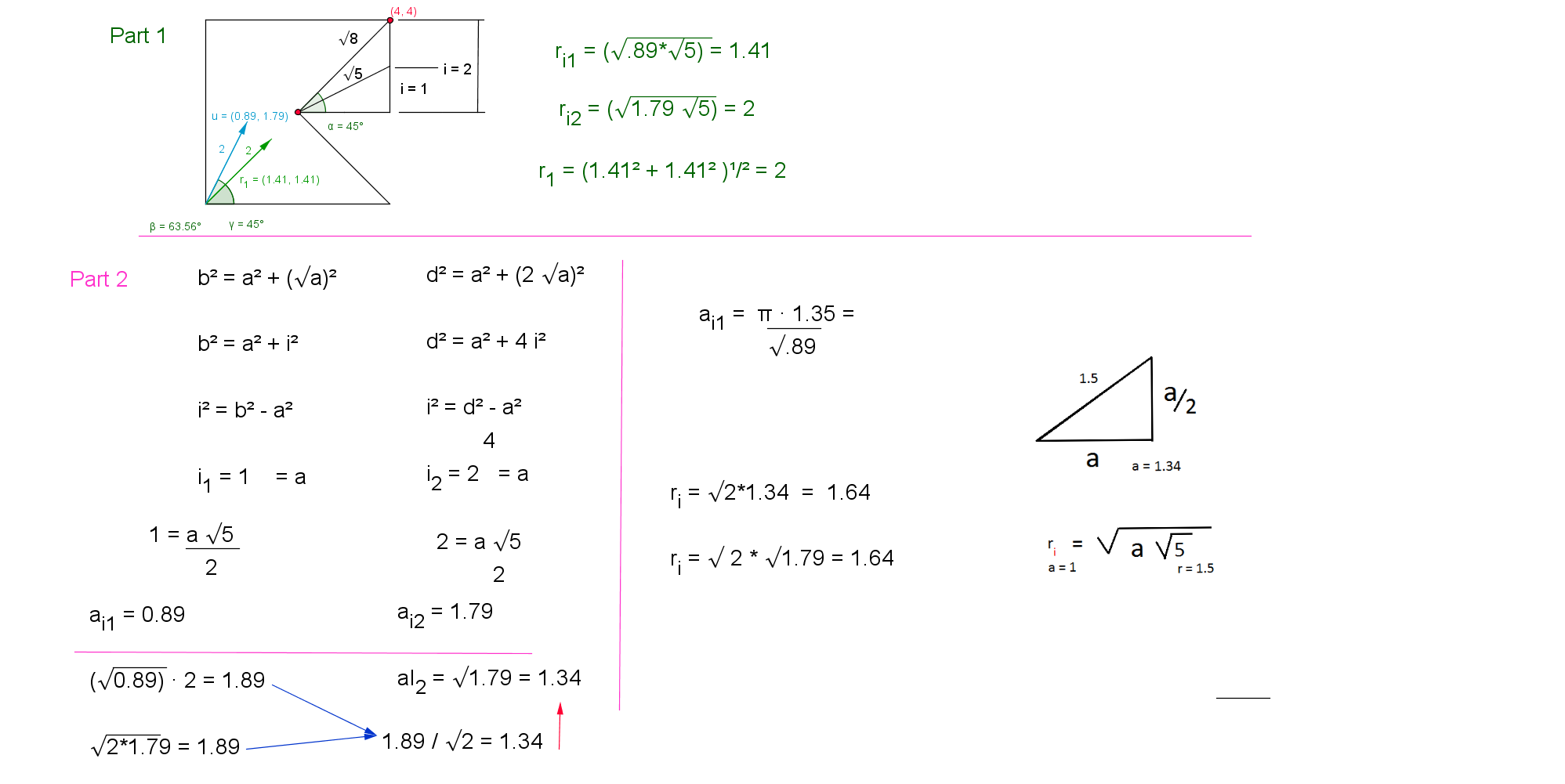
This example allows you to input functions and use geometry to abstract information from the function, involving trigonometric functions, vectors, and coordinate geometry. Commands used include semicircle, segment, circle, polygon, vector, angle, point, distance, intersect, mirror, textfield, slope, rotate, etc. Suitable for high school and above students or teachers.
GeoGebra Commands & Parameters
Semicircle(C, D) → cSemicircle(D, C) → dSegment(A, D) → aCircle(A, 1) → fSemicircle(E, F) → rSemicircle(F, E) → gPolygon(B, A, C, G) → poly1, b_1, a_1, c_1, g_1Vector((1.414213562373095, 1.414213562373095)) → u_3Vector((1.79, 0.89)) → vSegment(G, B) → ζ_1Segment(G, J) → hSegment(G, K) → iAngle(B, G, K) → α_uAngle(B, G, J) → β_vVector((0.89, 1.79)) → wSegment(G, L) → jAngle(B, G, L) → δ_wAngle(J, G, L) → Δ_vCircle(G, K) → kPoint(r) → NPoint(g) → MSegment(N, A) → pSegment(A, M) → qSegment(M, N) → sPolygon(N, C, G, B, M) → poly2, n_1, c_2, g_2, b_2, m_1Vector((2, 1)) → tVector((1, 2)) → uSegment(G, N) → d_1Segment(G, M) → e_1Angle(M, G, N) → α_tSegment(A, R) → k_1Segment(A, Q) → l_1Segment(Q, R) → p_1Circle(A, S) → q_1Distance(G, A) → distanceGAPoint(Circle[A, 3]) → TSegment(A, T) → r_1Point(Circle[G, 3]) → USegment(G, U) → s_1Point(Circle[T, 2.8284271247461903]) → VSegment(T, V) → t_1Distance(G, Q) → distanceGQDistance(G, M) → distanceGMSegment(G, M) → a_2Segment(W, Z) → d_2Vector(A_1, B_1) → u_2Vector(C_1, D_1) → v_2Distance(G, N) → distanceGNSegment(G, N) → f_2Distance(G, Q) → j_2Point(k) → E_1Point(k) → F_1Distance(F_1, E_1) → distanceF1E1Segment(E_1, F_1) → k_2Point(k_2) → G_1Point(s) → H_1Distance(G_1, H_1) → distanceG1H1Segment(G_1, H_1) → l_2Segment(I_1, J_1) → m_2Segment(K_1, L_1) → n_2Segment(K_2, L_2) → n_3Segment(K_3, L_3) → n_4Segment(K_4, L_4) → n_5Segment(K_5, L_5) → n_6Segment(K_8, L_8) → n_9Polygon(M_1, N_1, O_1, P_1) → poly3, m_3, n_{13}, o_2, p_2Intersect(k, q_1, 1) → Q_1Point(f_2) → R_1Circle(Q_1, R_1) → q_2Mirror(q_2, i) → r_2Segment(S_1, T_1) → a_3Segment(U_1, V_1) → b_3Intersect(f_3, i, 1) → W_1Point(f_3) → Z_1Segment(W_1, Z_1) → d_3Textfield(σ) → inputBox1Point(f_3) → C_2Point(f_3) → D_2Vector(G, D_2) → v_3Distance(G, D_2) → distanceGD2Vector(E_2, F_2) → w_3Mirror(N, p_1) → N'Mirror(A, p_1) → A'Segment(N', A') → p'Mirror(A, p_1) → A'_1Mirror(R, p_1) → R'Segment(A'_1, R') → g_3Mirror(A, p_1) → A'_2Mirror(M, p_1) → M'Segment(A'_2, M') → q'Mirror(A, p_1) → A'_3Mirror(Q, p_1) → Q'Segment(A'_3, Q') → h_3Segment(G, D_2) → i_3Slope(i_3) → m_4Point(p_3) → G_2Distance(G, G_2) → distanceGG2Vector(G, G_2) → j_3Segment(G, G_2) → l_3Angle(K, G, G_2) → αPoint(q_3) → H_2Point(s_3) → I_2Point(r_3) → J_2Polygon(H_2, I_2, J_2, G) → poly4, h_4, i_4, j_4, g_4Point(h_4) → M_2Point(j_4) → N_2Point(i_4) → O_2Point(g_4) → P_2Segment(O_2, M_2) → t_3Segment(N_2, P_2) → a_4Point(a_4) → Q_2Point(t_3) → R_2Segment(Q_2, R_2) → b_4Point(i_4) → T_2Point(f_4) → U_2Point(e_4) → S_2Segment(S_2, U_2) → k_4Point(p_4) → V_2Segment(G, V_2) → l_4Point(q_4) → W_2Point(κ) → Z_2Segment(G, W_2) → λSegment(G, Z_2) → r_4Angle(Z_2, G, W_2) → βVector(G, W_2) → ζPoint(κ) → A_3Point(κ) → B_3Segment(A_3, B_3) → ePoint(e) → D_3Textfield(μ) → inputBox2Rotate(A_3, 90*°, G) → E_3Rotate(B_3, 90*°, G) → F_3Segment(E_3, F_3) → e'Point(e) → C_3Rotate(A_3, 90*°, C_3) → G_3Rotate(B_3, 90*°, C_3) → H_3Segment(G_3, H_3) → e'_1Mirror(E_3, e'_1) → I_3Mirror(F_3, e'_1) → J_3Segment(I_3, J_3) → e''Point(e'') → M_3Point(e'') → N_3Segment(G, N_3) → s_4