
Convex, Concave and Self-Intersecting Polygons - Lesson+Exploration+Practice
Loading the math board and drawing, please wait…
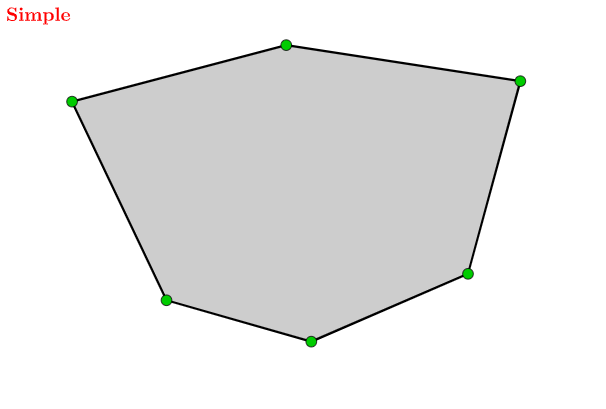
This example demonstrates the properties and differences between convex, concave, and self-intersecting polygons. Key math concepts include polygon classification, interior angles, side lengths, and diagonals. Construction highlights the use of GeoGebra commands like Polygon, InteriorAngles, Segment, and Angle. Suitable for high school students and math enthusiasts for geometry learning and exploration.
GeoGebra Commands & Parameters
Polygon(A, B, C, D, E, F) → poli1, a, b, c, d, e, fInteriorAngles(poli1) → α, β, γ, δ, ε, ζSegment(A, C) → gSegment(A, D) → hSegment(A, E) → iSegment(B, F) → jSegment(B, E) → kSegment(B, D) → lSegment(C, E) → mSegment(D, F) → nSegment(C, F) → pAngle(F, A, B) → alfa'Angle(A, B, C) → beta'Angle(B, C, D) → gamma'Angle(C, D, E) → delta'Angle(D, E, F) → epsilon'Angle(E, F, A) → fi'
AI Drawing Prompt Reference
Draw a closed polygon with six labeled vertices, connecting the points in order to form a single shape. Show all interior angles at each of the polygon’s corners. Then construct several additional segments (diagonals/connecting lines) between selected vertex pairs: connect the first vertex to the 3rd, 4th, and 5th vertices; connect the 2nd vertex to the 6th, 5th, and 4th vertices; also connect the 3rd to the 5th, the 4th to the 6th, and the 3rd to the 6th. Finally, display a set of specific angles determined by chosen triples of vertices at their middle points.
The prompt above was compiled from the original drawing commands and is for reference only.