
Convert 2π/3 Radians to Degrees – GeoGebra Example
Loading the math board and drawing, please wait…
In collections
CCGPS AA Unit 5 Lesson 1
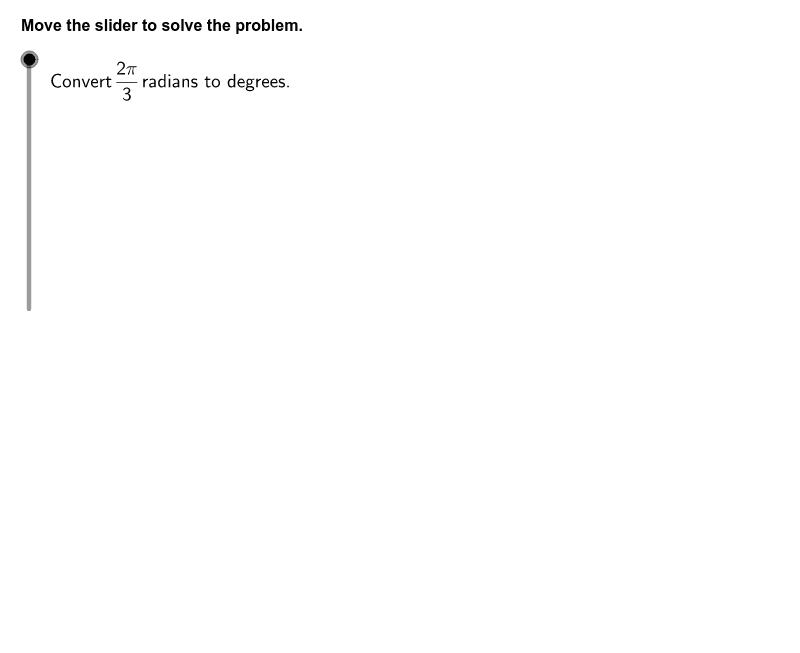
① This example demonstrates the conversion of 2π/3 radians into its degree measure. ② Core mathematical concepts: the radian‑degree conversion formula, the value of π, and basic trigonometric unit conversion. ③ Construction highlights: LaTeX for formula rendering, GCD to simplify fractions, If statements to control step visibility; objects such as radnum, radden for numerator/denominator, stepMax, stepper, steps, counter for stepwise animation, button1 and button2 for interactive controls, text0‑text11 for instructional labels, angleDeg and angleRad to store results, and equivalence to show the equality. ④ Intended for middle‑school or high‑school mathematics lessons on radian/degree conversion, as well as for self‑study or instructional material creation.
GeoGebra Commands & Parameters
LaTeX(steps) → counterLaTeX("\text{Determine which conversion factor to use.}") → text1LaTeX("\text{Set up the multiplication.}") → text4GCD(combnum, combden) → gcfLaTeX((((("\textcolor{#000099}{\frac{" * combnum) * "^{\circ}}{") * combden) * "}}")) → text7If(denom ≟ 1, LaTeX["\text{=}"], LaTeX["\text{\approx}"]) → equivalenceLaTeX((((((((("\textcolor{#000099}{\frac{" * radnum) * "\pi}{") * radden) * "}radians \text{ }") * equivalence) * "\text{ } ") * angleDeg) * "^{\circ}}")) → text10LaTeX((((("\text{Multiply }\frac{" * radnum) * " \pi}{") * radden) * "} \text{ radians by the conversion factor.}")) → text3LaTeX("\text{Use the buttons below to return to the original problem or}\cr\text{randomly generate a similar practice problem.}") → text11LaTeX("\text{Recall that }\pi\text{ radians = 180°. Thus, }\frac{180°}{\pi\text{ }radians}\text{ = 1, since dividing}\cr\text{one quantity by its equivalent is equal to 1. Since radians need to be}\cr\text{converted to degrees, multiply by }\frac{180°}{\pi}\text{ so that the radians in the}\cr\text{denominator will cancel out and degrees will remain.}") → text2LaTeX("\text{Reduce the fraction, if possible.}") → text8LaTeX((((((((((((((("\text{The greatest common factor of }\textcolor{#000099}{" * combnum) * "}\text{ and }\textcolor{#000099}{") * combden) * "}\text{ is }\textcolor{#000099}{") * gcf) * "}\text{, so the reduced}\cr\text{form of the exact measure of }\textcolor{#000099}{\frac{") * radnum) * "\pi\text{ radians}}{") * radden) * "}}\text{ in degrees is }\textcolor{#000099}{\frac{") * numer) * "°}{") * denom) * "}}.")) → text9LaTeX((((("\textcolor{#000099}{\frac{" * radnum) * " \pi\text{ }radians}{") * radden) * "}\bullet\frac{180^{\circ}}{\pi\text{ }radians}}")) → text5LaTeX((((("\text{Convert}\frac{" * radnum) * " \pi}{") * radden) * "} \text{radians to degrees.}")) → ProblemLaTeX("\text{Multiply, and cancel out the }\pi \text{ radians.}") → text6
AI Drawing Prompt Reference
Create an interactive step-by-step math worksheet that converts 2π/3 radians to degrees. Include a clear problem statement, explanatory text panels, fraction formulas, the conversion factor 180°/π, the multiplication and cancellation steps, a reduced fraction result, and the final degree measure. Add a visible step counter, a slider or stepper control for advancing through the steps, and two buttons to return to the original problem or generate a similar random practice problem. The layout should resemble an animated lesson with neatly typeset equations and labels that appear in sequence.
The prompt above was compiled from the original drawing commands and is for reference only.