
Constructions of Isosceles Triangles
Loading the math board and drawing, please wait…
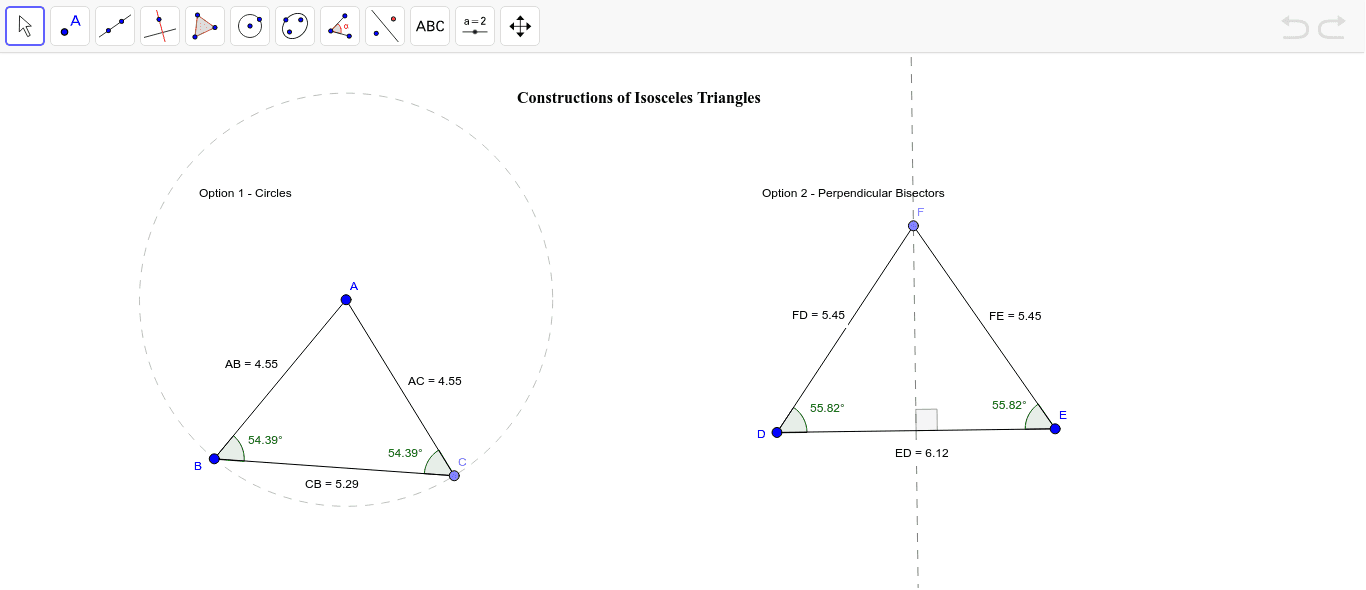
This example demonstrates how to construct isosceles triangles using GeoGebra commands. It involves core mathematical concepts such as geometric constructions, triangle properties, and relationships between angles and distances. Key construction steps include using commands like Circle, Segment, Point, Distance, Angle, and LineBisector. Suitable for middle school and above students to understand the construction methods and properties of isosceles triangles.
GeoGebra Commands & Parameters
Circle(A, B) → cSegment(A, B) → aPoint(c) → CSegment(A, C) → bDistance(A, C) → distanceACDistance(A, B) → distanceABSegment(C, B) → dDistance(C, B) → distanceCBAngle(A, C, B) → αAngle(C, B, A) → βSegment(D, E) → eLineBisector(e) → fPoint(f) → FSegment(F, D) → gSegment(F, E) → hDistance(F, D) → distanceFDDistance(F, E) → distanceFEDistance(E, D) → distanceEDAngle(F, E, D) → γAngle(E, D, F) → δAngle(e, f) → ε
AI Drawing Prompt Reference
Draw an isosceles triangle by first drawing a base line segment, then creating a circle with the base as the diameter. Mark the intersection points of the circle with the base as the apex of the triangle, and connect the apex to the endpoints of the base to form the isosceles triangle. Next, draw the perpendicular bisector of the base, and mark its intersection points with the circle as new apexes to form another isosceles triangle. Label the lengths of the sides and the measures of the angles.
The prompt above was compiled from the original drawing commands and is for reference only.