
Construction of Coefficients of i – Geometric Demonstration with Semicircle and
Loading the math board and drawing, please wait…
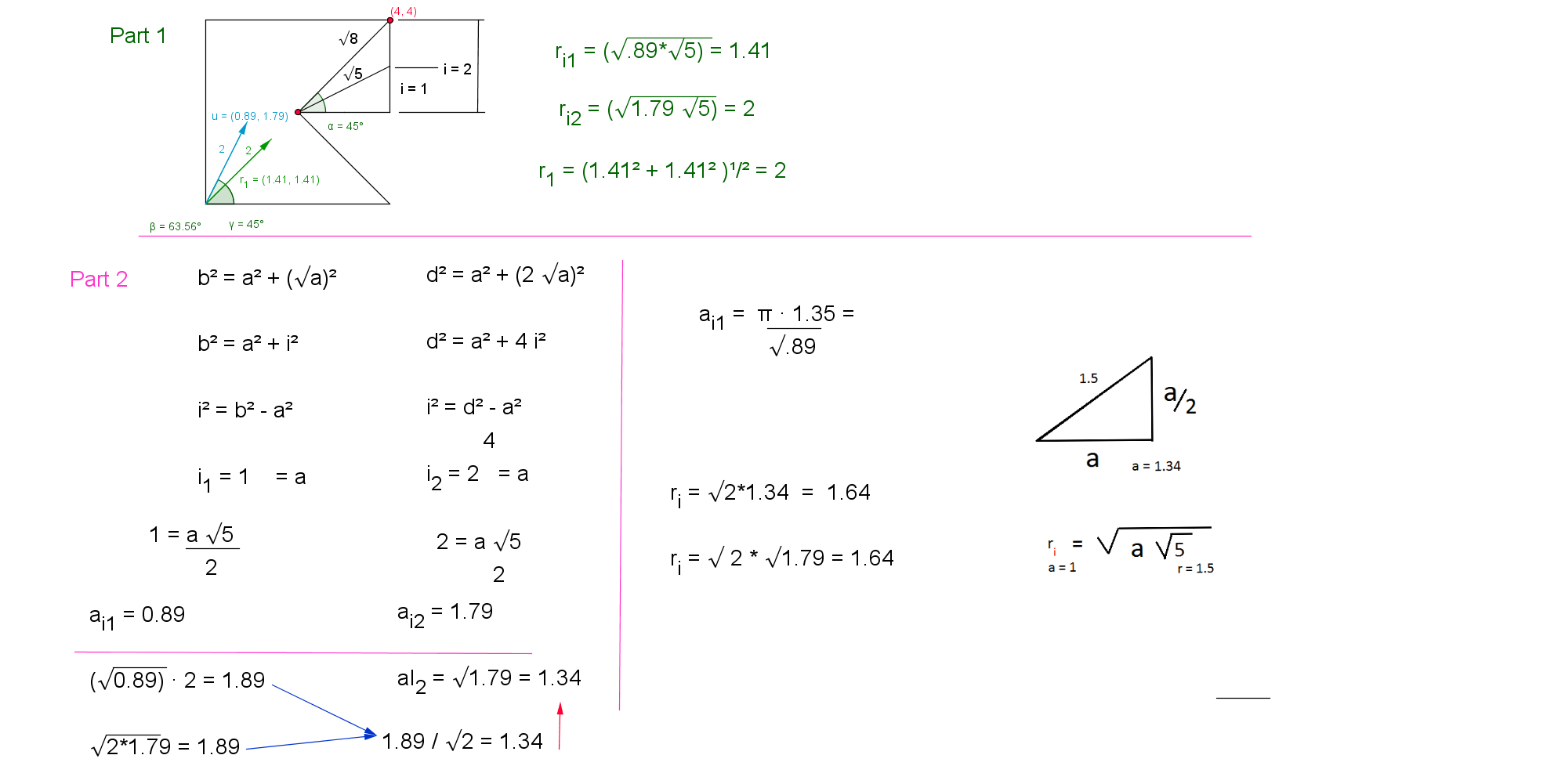
①This example demonstrates how the coefficients of the imaginary unit i in complex numbers can be constructed geometrically using a semicircle, segments, polygons, and mirror transformations. ②Core mathematical concepts include complex number representation, trigonometric functions (sine/cosine), ratios, variance, and the interplay between algebraic coefficients and geometric construction. ③Construction details: Based on the summary, the GeoGebra commands used are Semicircle, Segment, Circle, Polygon, Vector, Angle, Point, Distance, Intersect, and Mirror. Key objects include A, B, C, D, c, d, a, b, f, E, F, r, g, G, poly1, b_1, a_1, c_1, g_1, m, H, I, pic1, u_3, v, e, J, h, K, i, α_u, β_v, w, L, j, δ_w, Δ_v, k, l, n, which are arranged to reveal the coefficient structure step by step. ④This is suitable for high school or early college students learning the geometric meaning of complex numbers and trigonometric functions, and can serve as a classroom demonstration or self-guided exploration connecting algebra and geometry.
GeoGebra Commands & Parameters
Semicircle(C, D) → cSemicircle(D, C) → dSegment(A, D) → aCircle(A, 1) → fSemicircle(E, F) → rSemicircle(F, E) → gPolygon(B, A, C, G) → poly1, b_1, a_1, c_1, g_1Vector((1.414213562373095, 1.414213562373095)) → u_3Vector((1.79, 0.89)) → vSegment(G, B) → eSegment(G, J) → hSegment(G, K) → iAngle(B, G, K) → α_uAngle(B, G, J) → β_vVector((0.89, 1.79)) → wSegment(G, L) → jAngle(B, G, L) → δ_wAngle(J, G, L) → Δ_vCircle(G, K) → kPoint(r) → NPoint(g) → MSegment(N, A) → pSegment(A, M) → qSegment(M, N) → sPolygon(N, C, G, B, M) → poly2, n_1, c_2, g_2, b_2, m_1Vector((2, 1)) → tVector((1, 2)) → uSegment(G, N) → d_1Segment(G, M) → e_1Angle(M, G, N) → α_tSegment(A, R) → k_1Segment(A, Q) → l_1Segment(Q, R) → p_1Circle(A, S) → q_1Distance(G, A) → distanceGAPoint(Circle[A, 3]) → TSegment(A, T) → r_1Point(Circle[G, 3]) → USegment(G, U) → s_1Point(Circle[T, 2.8284271247461903]) → VSegment(T, V) → t_1Distance(G, Q) → distanceGQDistance(G, M) → distanceGMSegment(G, M) → a_2Segment(W, Z) → d_2Vector(A_1, B_1) → u_2Vector(C_1, D_1) → v_2Distance(G, N) → distanceGNSegment(G, N) → f_2Distance(G, Q) → j_2Point(k) → E_1Point(k) → F_1Distance(F_1, E_1) → distanceF1E1Segment(E_1, F_1) → k_2Point(k_2) → G_1Point(s) → H_1Distance(G_1, H_1) → distanceG1H1Segment(G_1, H_1) → l_2Segment(I_1, J_1) → m_2Segment(K_1, L_1) → n_2Segment(K_2, L_2) → n_3Segment(K_3, L_3) → n_4Segment(K_4, L_4) → n_5Segment(K_5, L_5) → n_6Segment(K_8, L_8) → n_9Polygon(M_1, N_1, O_1, P_1) → poly3, m_3, n_{13}, o_2, p_2Intersect(k, q_1, 1) → Q_1Point(f_2) → R_1Circle(Q_1, R_1) → q_2Mirror(q_2, i) → r_2Segment(S_1, T_1) → a_3Segment(U_1, V_1) → b_3