
Construction of a Right Prism with Reflection Symmetry
Loading the math board and drawing, please wait…
In collections
Surface Area Geogebra
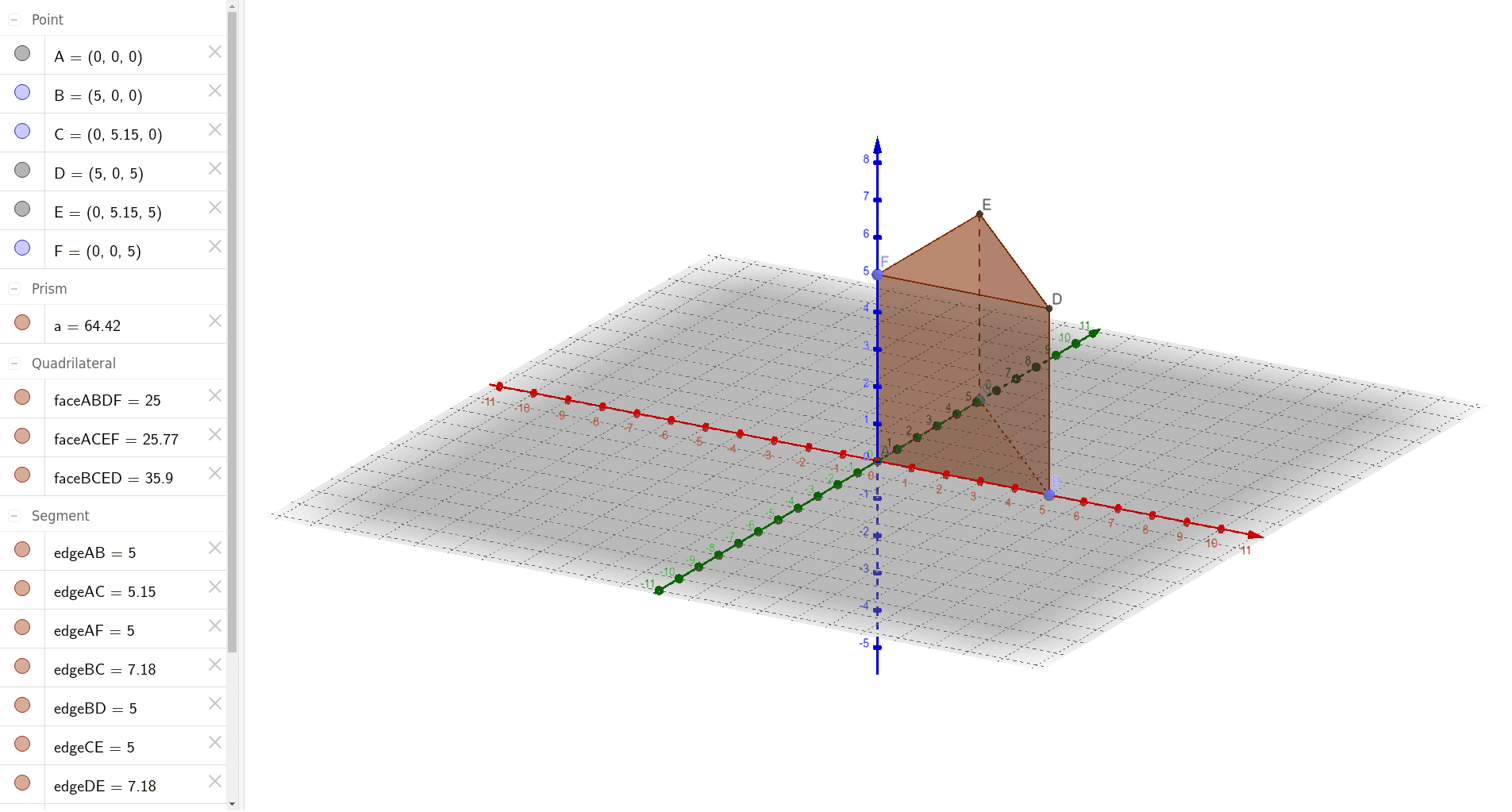
This GeoGebra example demonstrates a right prism with a trapezoidal base, showcasing its three-dimensional structure along with reflection and similarity transformations. The core mathematical concepts include the definition of a prism (two congruent parallel bases and rectangular lateral faces), reflection symmetry, similarity ratios, and the use of definite integrals for computing volumes or areas. Construction details: the GeoGebra commands used are Intersect (to find intersection points), Point (to create vertices), and Prism (to generate the solid directly); objects include base vertices A, B, C, F, remaining vertices D and E, faces (faceABC, faceABDF, etc.), and edges (edgeAB, edgeBC, etc.). This is suitable for high school or early college students learning solid geometry, symmetry transformations, and integration, and serves as an interactive teaching tool for exploring prism properties and 3D modeling.
GeoGebra Commands & Parameters
Intersect(zAxis, xAxis) → APoint(xAxis) → BPoint(yAxis) → CPoint(zAxis) → FPrism(A, B, C, F) → a, D, edgeAC, edgeAF, edgeBD, edgeCE, edgeDF, edgeDE, edgeEF, E, faceABC, faceABDF, faceBCED, faceACEF, faceDEF, edgeAB, edgeBC