
Construction of a Kite: Geometric Construction and Measurement
Loading the math board and drawing, please wait…
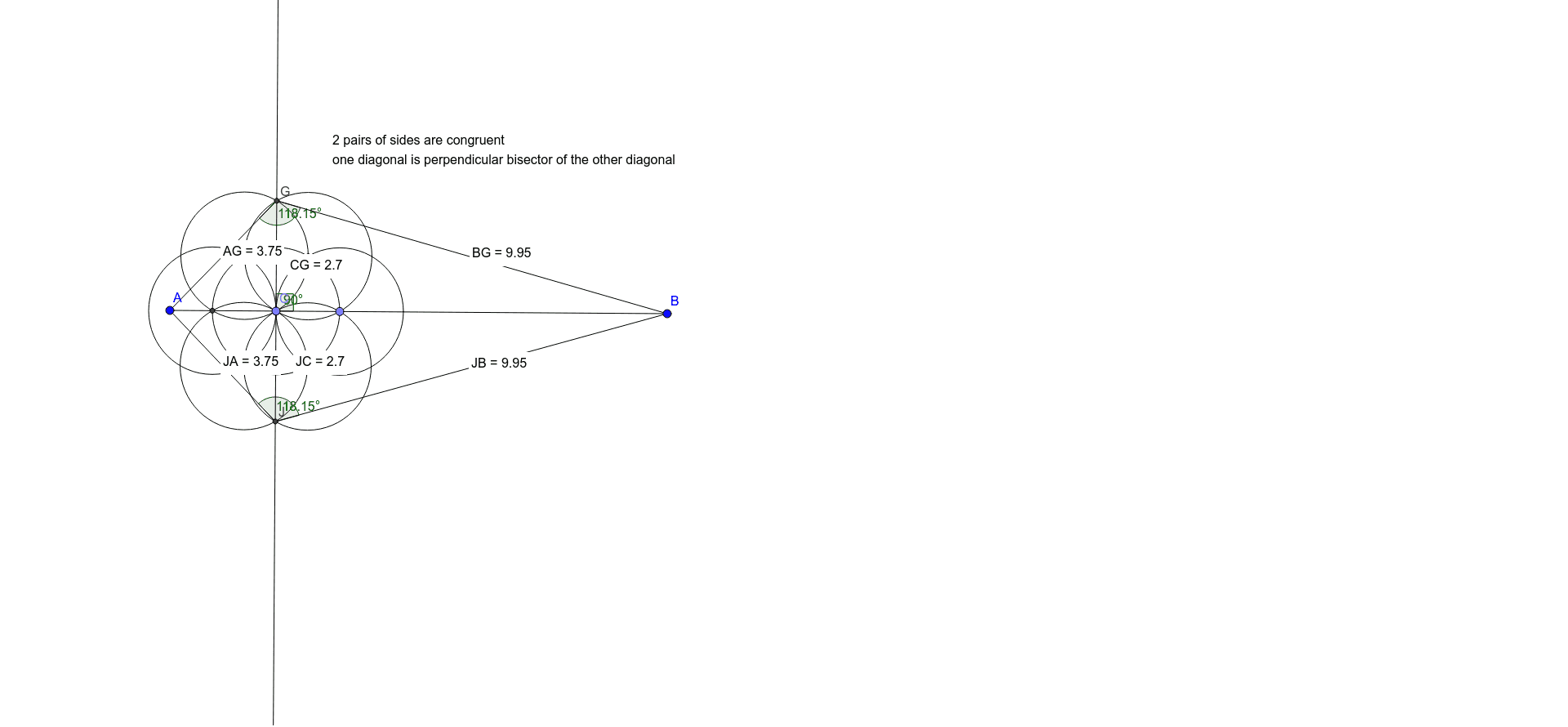
This GeoGebra example demonstrates the step-by-step construction of a kite (a quadrilateral with two pairs of adjacent equal sides) and dynamically displays measurements of side lengths, angles, and diagonal-related distances. Core mathematical concepts include the definition and properties of a kite, symmetry, triangle congruence, and the use of trigonometry for angle calculations. The construction uses commands such as Segment, Point, Circle, Intersect, Line, Distance, and Angle, creating points A, B, C, D, auxiliary circles f, lines c and d, and multiple distance text objects (e.g., distanceJB, distanceBG, distanceAG, distanceJA) along with angles α, β, γ. This resource is suitable for middle school to high school students learning geometric construction, quadrilateral properties, and trigonometric applications. It serves as an interactive tool for teachers to demonstrate or students to explore the kite's symmetry and perpendicular diagonals.
GeoGebra Commands & Parameters
Segment(A, B) → fPoint(f) → CPoint(f) → DCircle(C, Segment[C, D]) → cCircle(D, Segment[C, D]) → dIntersect(c, d, 1) → ECircle(E, Segment[C, E]) → eIntersect(c, e, 1) → FCircle(F, Segment[E, F]) → gIntersect(e, g, 2) → GLine(C, G) → hIntersect(c, d, 2) → HCircle(H, Segment[C, H]) → kIntersect(c, k, 2) → ICircle(I, Segment[I, H]) → pIntersect(k, p, 1) → JIntersect(c, g, 1) → KCircle(K, Segment[C, K]) → qSegment(A, J) → iSegment(A, G) → jSegment(G, B) → lSegment(B, J) → mDistance(J, B) → distanceJBDistance(B, G) → distanceBGDistance(A, G) → distanceAGDistance(J, A) → distanceJAAngle(B, C, G) → αAngle(A, G, B) → βAngle(B, J, A) → γDistance(J, C) → distanceJCDistance(C, G) → distanceCG