
Constructing Three Tetrahedrons
Loading the math board and drawing, please wait…
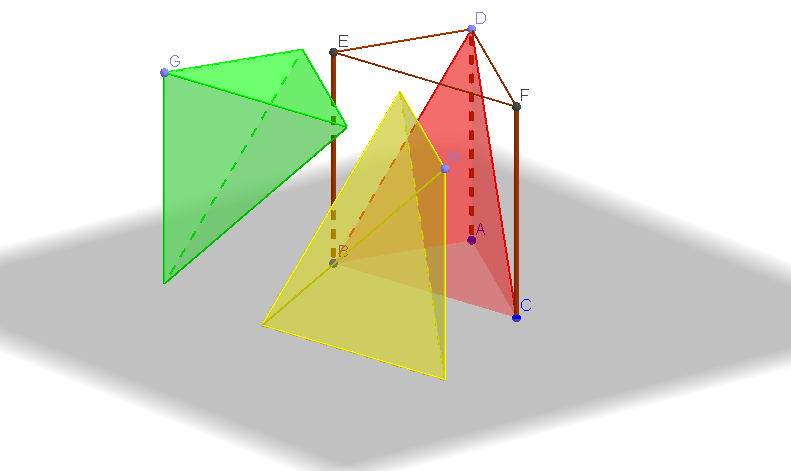
This example demonstrates how to cut a prism into three tetrahedrons of equal volume. Key mathematical concepts include solid geometry volume calculation and geometric construction. Using GeoGebra commands such as Polygon, OrthogonalLine, and Point, the prism and tetrahedrons are constructed. Suitable for high school geometry learners and educators.
GeoGebra Commands & Parameters
Polygon(A, B, C) → poly1, c, a, bOrthogonalLine(A, xOyPlane) → dPoint(d) → DPrism(poly1, D) → e, E, edgeDE, edgeEF, edgeDF, F, faceABED, faceBCFE, faceACFD, faceDEF, edgeAD_1, edgeBE_1, edgeCFPyramid(poly1, D) → f, faceABD, faceBCD_1, faceACD, edgeAD, edgeBD_1, edgeCDPyramid(faceDEF, B) → g, faceBDE, faceBEF, faceBDF_1, edgeBD_2, edgeBE, edgeBF_1Polygon(F, D, C) → poly2, c_1, f_1, d_1Pyramid(poly2, B) → h, faceBDF, faceBCD, faceBCF, edgeBF, edgeBD, edgeBCOrthogonalPlane(D, d) → iPointIn(i) → GPointIn(i) → HVector(E, G) → uTranslate(g, u) → g'Vector(F, H) → vTranslate(h, v) → h'
AI Drawing Prompt Reference
Start with a triangular base and a point directly above one vertex to form a triangular prism. Construct a pyramid with the base as its bottom and the top point as its apex. Then, using the prism's top face as a base and another bottom vertex as apex, build a second pyramid. Finally, use a partial triangle of the top face with the bottom vertex to form a third pyramid. Take two points on a plane perpendicular to the prism's height, create vectors from two top vertices to these points, and translate the last two pyramids along these vectors so that all three tetrahedrons have equal volume and do not overlap.
The prompt above was compiled from the original drawing commands and is for reference only.